
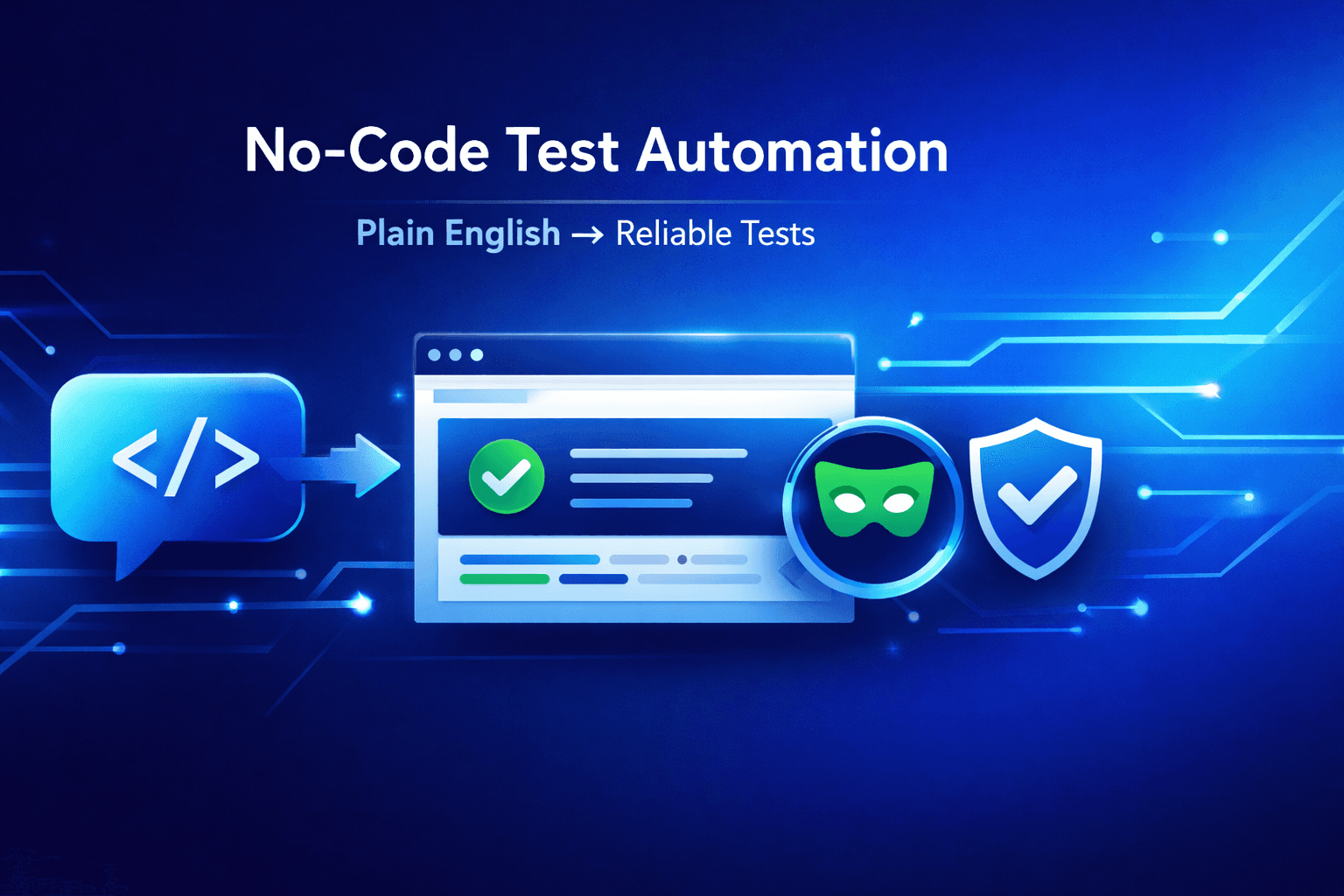
What happens when you combine the precision of automated testing with the simplicity of natural language? A revolution in how teams approach quality assurance.
There was a time when test automation meant one thing: developers sitting at their keyboards, writing hundreds or thousands of lines of code to test other code. It was tedious. It was expensive. And frankly, it created a bottleneck that most software teams simply accepted as the cost of doing business.
That era is ending. Not with a whimper, but with a fundamental shift in how we think about quality assurance.
Understanding No Code Test Automation
No code test automation does exactly what the name suggests. It allows teams to create, maintain, and execute automated tests without writing traditional programming code. But here is the interesting part: the code still exists. Someone or something is still writing it. The difference is that you are not the one doing it.
Think about it like dictation software. When you speak into your phone and it transcribes your words, you are not physically typing. But text is still being created. No code test automation works on a similar principle. You describe what you want to test in plain English, and the system generates the underlying code that makes it happen.
This is not a compromise on quality or capability. Modern no code platforms produce the same rigorous, repeatable tests that a skilled automation engineer would write. They just remove the manual labor from the equation.
At Checksum, you write what you want in plain english, and Playwright code is generated. On top of that when the UX in the app changes, the code is automatically updated and your tests are run.
How Checksum Writes Code For You
Let me walk you through what this actually looks like in practice. Tools like Checksum have built sophisticated systems that translate your intentions into executable test scripts. You tell the system what you need, and it figures out how to make it happen.
Say you want to test a login flow. In the traditional world, you would write Selenium or Cypress code, handle element selectors, manage waits, deal with authentication tokens, and wrestle with edge cases. It might take an experienced developer hours to get a reliable test working.
With Checksum, you might simply write something like: "Test the login page. Enter a valid email address and password. Click the sign in button. Verify the user reaches the dashboard. Check that their name appears in the navigation bar."
The platform reads this, understands the intent, and generates production quality test code. It handles the selectors. It manages the timing. It builds in proper assertions. And when the application changes, the system can often adapt automatically because it understands what you were trying to accomplish, not just which specific buttons you wanted to click.
We will give you a no obligation demo of how this works in your environment. Just contact us!
The Hidden Intelligence Behind Plain English Testing
What makes this work is not magic. It is a combination of natural language processing, machine learning models trained on millions of test scenarios, and deep understanding of web application architecture. When you write "verify the user reaches the dashboard," the system knows to check for URL changes, wait for page loads, and confirm visual elements that indicate a successful navigation.
This intelligence layer does more than just translate words into actions. It anticipates problems. It knows that login forms often have validation errors, so it builds in checks for error messages. It understands that network requests can fail, so it implements retry logic. It recognizes that dynamic content takes time to load, so it waits appropriately.
All of this happens without you thinking about it. You focus on what you want to verify. The system worries about how to verify it reliably.
Why Traditional Automation Falls Short
To appreciate the value of no code approaches, consider the pain points they address. Traditional test automation has several fundamental challenges that have plagued QA teams for decades.
First, there is the expertise barrier. Writing good test automation requires programming skills, knowledge of testing frameworks, understanding of the application under test, and experience with common pitfalls. Finding people with all these skills is difficult and expensive. Prospects often think they can hire a off shore entry level to write this, but because of lack of experience this often leads to testing being slow, and often incorrect. Remember the old saying "garbage in, garbage out".
Second, maintenance becomes overwhelming. Applications change constantly. Every UI update, every new feature, every design refresh has the potential to break existing tests. Teams often spend more time fixing tests than creating new ones. Some organizations report that up to 60 percent of their automation effort goes into maintenance rather than new coverage.
Third, there is the knowledge silo problem. When the person who wrote the tests leaves the team, their code often becomes incomprehensible to others. Tribal knowledge evaporates. Documentation falls out of date. New team members struggle to understand why tests were written the way they were.
"No code test automation" addresses each of these issues directly. You do not need programming expertise because you are writing in plain language. Maintenance is simpler because the system understands intent, not just implementation. And anyone can read and understand tests written in natural language, regardless of their technical background.
The Business Case for Going Codeless
Money talks, and the financial argument for no code test automation is compelling. Consider the full cost of traditional automation: salaries for specialized engineers, training time for new team members, hours lost to maintenance, and the opportunity cost of delayed releases when test suites fail.
Organizations that switch to no code approaches typically see dramatic improvements. Tests get created faster, often three to five times faster than traditional methods. Maintenance overhead drops significantly because AI powered systems can self heal when applications change. And because anyone on the team can contribute to testing, the bottleneck around specialized resources disappears.
One pattern that emerges repeatedly: product managers and business analysts start writing tests. These are people who understand the requirements deeply but never would have touched test code. Suddenly they are contributing directly to quality assurance, catching issues they know to look for because they designed the features in the first place.
Real World Applications
No code test automation shines across multiple testing scenarios. End to end testing of user workflows becomes accessible to entire teams. Regression testing that used to require weeks of script updates now adapts automatically. Cross browser and cross device testing scales effortlessly because the underlying code handles the complexity.
API testing benefits too. Describing a sequence of API calls in plain language and validating responses works naturally. Integration tests between systems become conversations rather than complex code modules. Even performance testing, traditionally one of the most technical disciplines, becomes more accessible when you can describe scenarios in everyday terms.
The applications extend beyond pure testing. No code automation helps with data setup, allowing teams to describe the test data they need. It assists with environment configuration, making it possible to specify deployment requirements naturally. Some organizations use similar approaches for production monitoring, describing the checks they want to run against live systems.
Addressing the Skeptics
Some engineers resist the idea of no code test automation. Their concerns deserve serious consideration, but most do not hold up under scrutiny.
"It is not as powerful as real code." Actually, modern no code platforms generate the same code that experts would write. The output is production quality automation that handles edge cases, implements best practices, and runs reliably. The abstraction layer does not limit capability; it just simplifies access.
"I lose control over what the system does." Valid concern, but most platforms allow you to inspect, modify, and extend the generated code when needed. You can start with natural language and drop into code for specific customizations. The best of both worlds.
"It will not handle my complex scenarios." Perhaps the most common objection, and also the most unfounded. No code tools handle sophisticated testing requirements including conditional logic, data driven testing, parallel execution, and integration with CI/CD pipelines. The natural language interface does not mean simplistic capabilities.
The more interesting question is not whether no code can match traditional automation, but whether the time spent writing code manually provides any real advantage. In most cases, it does not.
Getting Started With No Code Testing
Transitioning to no code test automation does not require abandoning existing investments. Most teams find that a gradual approach works best. Start with new tests for new features. Let the no code system prove its value before migrating legacy automation.
Begin with the tests that cause the most pain. The flaky ones that fail intermittently. The brittle ones that break with every deployment. The ones that require constant attention. These are perfect candidates for no code alternatives because they demonstrate value quickly.
Pay attention to test design principles even when you are not writing code. Good tests have clear objectives, cover meaningful scenarios, and provide actionable feedback when they fail. Natural language makes it easier to articulate these qualities, but you still need to think about what you are testing and why.
Invest time in learning the platform's capabilities. No code tools vary in their strengths and approaches. Understanding what your chosen tool does well helps you get maximum value. Take advantage of training resources, documentation, and community knowledge.
The Future of Quality Assurance: No Code Testing
Where does this trend lead? I see no code test automation as part of a broader shift toward intent based computing. We are moving from telling computers exactly what to do toward describing what we want to achieve and letting sophisticated systems figure out the details.
Testing is a perfect application for this paradigm. Tests fundamentally express expectations: what should happen when users interact with software. Expressing those expectations in natural language is more intuitive than encoding them in programming syntax.
The role of QA professionals will evolve. Less time writing and maintaining scripts means more time thinking strategically about quality. What should we test? Where are the risks? How do we measure success? These higher level questions become the focus when mechanical work is automated away.
Teams will test more comprehensively. When creating tests requires minimal effort, there is no excuse for sparse coverage. Organizations will automate scenarios they previously considered too expensive to maintain. Quality will improve as a result.
The barrier between development and testing will blur further. When anyone can write tests, the whole team takes ownership of quality. Testing shifts left and right simultaneously, integrated throughout the development lifecycle rather than bolted on at the end.
This is not speculation. These changes are already happening in organizations that have embraced no code test automation. The question is not if this transformation will reach your team, but when.
FAQs
What exactly is no code test automation?
No code test automation allows teams to create automated software tests without writing traditional programming code. You describe what you want to test in plain English or through visual interfaces, and the platform generates the underlying test scripts automatically. The tests still run as code behind the scenes, but you never have to write or maintain that code yourself.
How does Checksum write the code for me?
Checksum uses artificial intelligence and natural language processing to understand your testing intentions. When you describe a test scenario, like testing that a user can successfully log in and view their profile, the system translates that description into executable test code. It handles element identification, timing waits, assertions, and error handling automatically based on established testing patterns and best practices.
Can no code tests handle complex scenarios?
Yes. Modern no code platforms support sophisticated testing requirements including conditional logic, loops, data driven testing, API integrations, database validations, and multi step workflows. The natural language interface simplifies how you express these requirements but does not limit what you can accomplish. Complex enterprise applications with intricate business logic are tested successfully using no code approaches.
What happens when my application changes?
This is where no code automation often outperforms traditional approaches. Because the system understands what you intended to test, not just which specific elements to interact with, it can often adapt automatically when your application updates. Many platforms include self healing capabilities that update selectors and adjust timing without manual intervention. Significant changes may still require test updates, but maintenance burden drops substantially.
Is no code test automation reliable enough for production use?
Absolutely. No code platforms generate the same quality of test code that experienced automation engineers would write. The output is not simplified or limited. Many organizations run thousands of no code tests daily as part of their continuous integration pipelines with the same reliability expectations as traditionally coded automation. Fortune companies use Checksum to run their QA testing.
How does no code testing integrate with existing development workflows?
Most no code testing platforms integrate with standard development tools including GitHub, GitLab, Jenkins, CircleCI, and other CI/CD systems. Tests can be triggered automatically on code commits, run on schedules, and report results to existing dashboards. The platform handles the integration details so tests feel like a natural part of your development process.
Can I modify the generated code if needed?
Many platforms allow you to view and edit the underlying code when necessary. This hybrid approach gives you the speed and accessibility of no code creation with the flexibility of traditional automation for edge cases. In the Checksum platform, you can basically toggle between interfaces.
What types of testing work best with no code approaches?
End to end testing of user workflows is the most common application. Regression testing, smoke testing, and cross browser validation all work well. API testing, integration testing, and database verification are often supported.
How long does it take to create tests with no code automation?
Most teams report creating tests three to five times faster than traditional automation approaches. Simple test scenarios might take minutes rather than hours. Complex workflows that would require days of development can often be completed in a few hours. The time savings increase further when you factor in reduced maintenance overhead.
Is no code test automation expensive?
Pricing varies by platform, but the total cost of ownership is typically lower than traditional automation. You spend less on specialized engineering talent, less on training, and less on maintenance. Many organizations find that no code testing pays for itself within months through reduced labor costs and faster release cycles. Most vendors offer trials so you can evaluate value before committing.

Neel Punatar is an engineer from UC Berkeley - Go Bears! He has worked at places like NASA and Cisco as an engineer but quickly switched to marketing for tech. He has worked for companies like Wikipedia, OneLogin, Zenefits, and Foxpass before joining Checksum. He loves making engineers more productive with the tools he promotes.