Checksum is now a Google Partner
・
Checksum AI and Google Cloud: End-to-End Testing AI Innovation
Checksum is now a Google Partner
・
Checksum AI and Google Cloud: End-to-End Testing AI Innovation
Checksum is now
a Google Cloud Partner

February 3, 2026
The True Cost of Maintaining a Test Suite
The True Cost of Maintaining a Test Suite
The True Cost of Maintaining a Test Suite
Why test maintenance is more expensive than you think, and how to calculate what you're actually spending
Why test maintenance is more expensive than you think, and how to calculate what you're actually spending
Why test maintenance is more expensive than you think, and how to calculate what you're actually spending
Test automation is sold on efficiency: write the test once, run it forever. The reality is different. Tests break constantly, and someone has to fix them. That someone is usually your most experienced engineer, and they're not cheap.
At Checksum AI, we've analyzed maintenance costs across hundreds of customer teams. This article breaks down what test maintenance actually costs, where the money goes, and how AI-assisted maintenance changes the economics.
For failure rate data and root cause analysis, we draw on our study of over one million test runs, detailed in our companion blog article Real Customer Data: What Breaks and How Often.
Test automation is sold on efficiency: write the test once, run it forever. The reality is different. Tests break constantly, and someone has to fix them. That someone is usually your most experienced engineer, and they're not cheap.
At Checksum AI, we've analyzed maintenance costs across hundreds of customer teams. This article breaks down what test maintenance actually costs, where the money goes, and how AI-assisted maintenance changes the economics.
For failure rate data and root cause analysis, we draw on our study of over one million test runs, detailed in our companion blog article Real Customer Data: What Breaks and How Often.
Test automation is sold on efficiency: write the test once, run it forever. The reality is different. Tests break constantly, and someone has to fix them. That someone is usually your most experienced engineer, and they're not cheap.
At Checksum AI, we've analyzed maintenance costs across hundreds of customer teams. This article breaks down what test maintenance actually costs, where the money goes, and how AI-assisted maintenance changes the economics.
For failure rate data and root cause analysis, we draw on our study of over one million test runs, detailed in our companion blog article Real Customer Data: What Breaks and How Often.
The Hidden Cost Problem
The Hidden Cost Problem
The Hidden Cost Problem
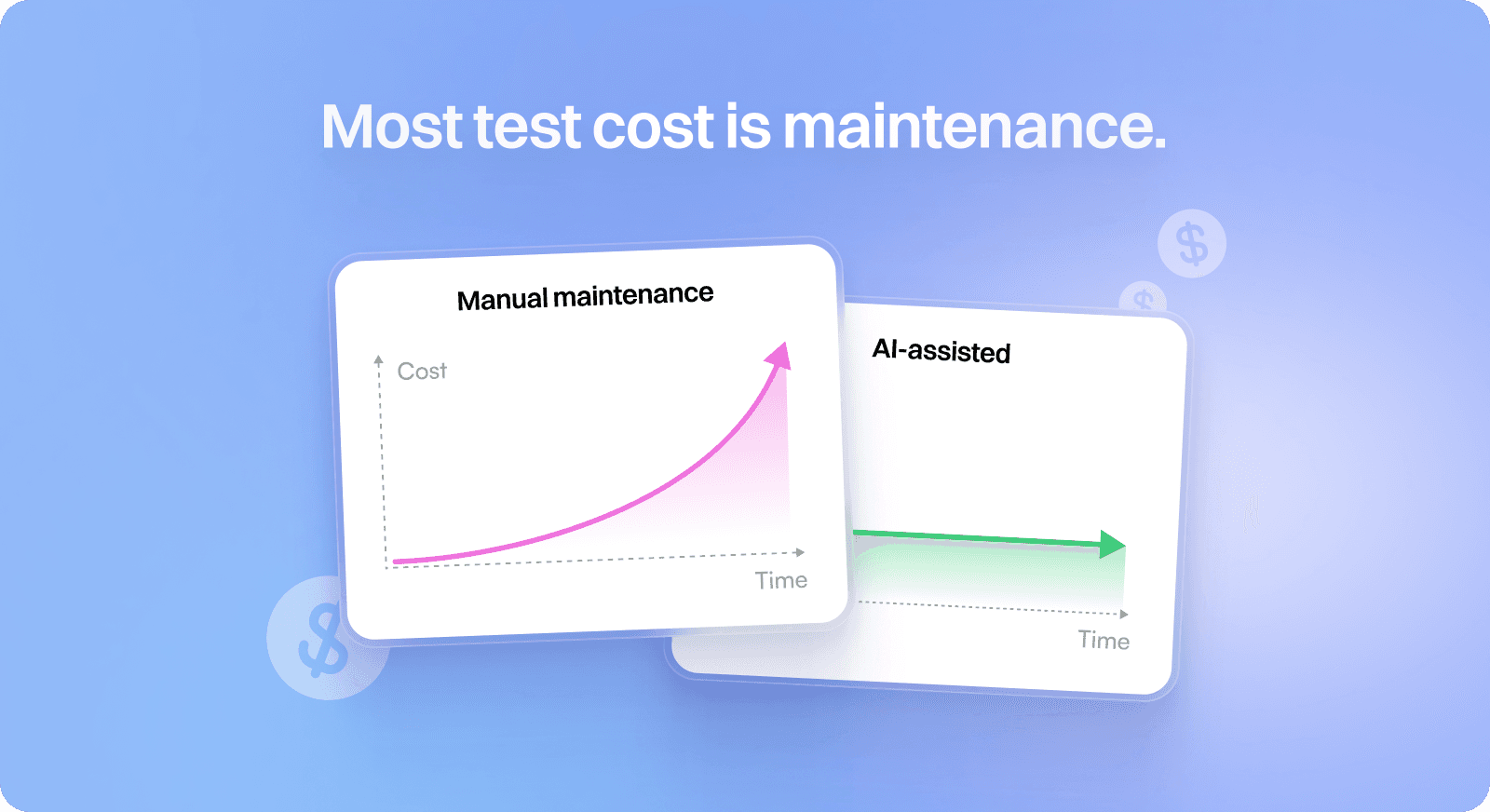
Test maintenance is invisible until it isn't. Unlike feature work, it doesn't show up on roadmaps. Unlike incidents, it doesn't trigger alerts. It lives in the space between—a tax on engineering time that accumulates quietly.
Most teams don't track it. When we ask engineering managers how much time their team spends on test maintenance, the typical answer is "not much" or "a few hours a week." When we instrument the actual time, the numbers are consistently higher.
The gap exists because maintenance is fragmented. Ten minutes here debugging a selector. Twenty minutes there waiting for CI to confirm a fix. An hour lost to a flaky test that turns out to be a real bug. None of these feel significant in isolation. Together, they add up.
Test maintenance is invisible until it isn't. Unlike feature work, it doesn't show up on roadmaps. Unlike incidents, it doesn't trigger alerts. It lives in the space between—a tax on engineering time that accumulates quietly.
Most teams don't track it. When we ask engineering managers how much time their team spends on test maintenance, the typical answer is "not much" or "a few hours a week." When we instrument the actual time, the numbers are consistently higher.
The gap exists because maintenance is fragmented. Ten minutes here debugging a selector. Twenty minutes there waiting for CI to confirm a fix. An hour lost to a flaky test that turns out to be a real bug. None of these feel significant in isolation. Together, they add up.
Test maintenance is invisible until it isn't. Unlike feature work, it doesn't show up on roadmaps. Unlike incidents, it doesn't trigger alerts. It lives in the space between—a tax on engineering time that accumulates quietly.
Most teams don't track it. When we ask engineering managers how much time their team spends on test maintenance, the typical answer is "not much" or "a few hours a week." When we instrument the actual time, the numbers are consistently higher.
The gap exists because maintenance is fragmented. Ten minutes here debugging a selector. Twenty minutes there waiting for CI to confirm a fix. An hour lost to a flaky test that turns out to be a real bug. None of these feel significant in isolation. Together, they add up.
The Cost Model
The Cost Model
Test maintenance cost is straightforward to model once you have the right inputs:
Monthly maintenance cost = Failures per month × Time per failure × Engineer hourly rate
The challenge is getting accurate numbers for each variable. Let's break them down.
Test maintenance cost is straightforward to model once you have the right inputs:
Monthly maintenance cost = Failures per month × Time per failure × Engineer hourly rate
The challenge is getting accurate numbers for each variable. Let's break them down.
Test maintenance cost is straightforward to model once you have the right inputs:
Monthly maintenance cost = Failures per month × Time per failure × Engineer hourly rate
The challenge is getting accurate numbers for each variable. Let's break them down.
Failures Per Month
Failures Per Month
Failures Per Month
From our analysis of 1M+ test runs, teams without AI-assisted maintenance see a median of 14.8 failures per 100 test runs.
From our analysis of 1M+ test runs, teams without AI-assisted maintenance see a median of 14.8 failures per 100 test runs.
From our analysis of 1M+ test runs, teams without AI-assisted maintenance see a median of 14.8 failures per 100 test runs.
Suite Size
Tests
Daily Runs
Failure Rate
Monthly Failures
Small
100
15
14.8%
222
Large
500
25
14.8%
1,850
Note: These are median failure rates. Teams at P75 or P90 see significantly more.
Note: These are median failure rates. Teams at P75 or P90 see significantly more.
Note: These are median failure rates. Teams at P75 or P90 see significantly more.
Time Per Failure
Time Per Failure
Time Per Failure
Not all failures take the same time to fix. From our root cause analysis:
Not all failures take the same time to fix. From our root cause analysis:
Not all failures take the same time to fix. From our root cause analysis:
Root Cause
Share of Failures
Average Fix Time
Selector changes
32%
45 min
Flow changes
27%
2.1 hours
Environment instability
22%
1.5 hours
Loading/timing
19%
40 min
When you weight these by frequency and add overhead for context switching, CI wait times, and occasional misdiagnosis, the realistic all-in time per failure for human-only maintenance is approximately 1.3 hours.
When you weight these by frequency and add overhead for context switching, CI wait times, and occasional misdiagnosis, the realistic all-in time per failure for human-only maintenance is approximately 1.3 hours.
When you weight these by frequency and add overhead for context switching, CI wait times, and occasional misdiagnosis, the realistic all-in time per failure for human-only maintenance is approximately 1.3 hours.
Cost Per Failure Type
Cost Per Failure Type
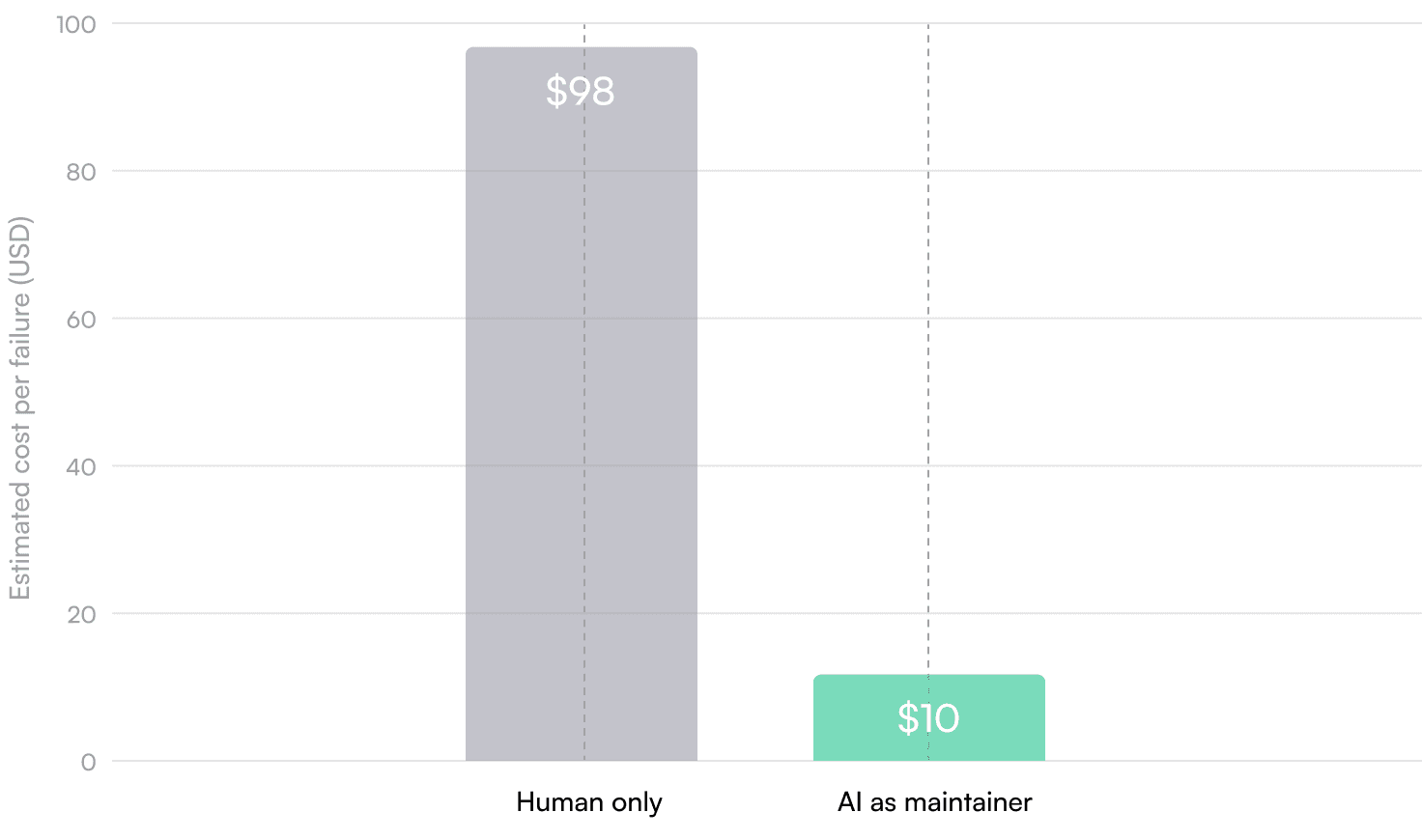
Using an effective engineer rate of $60/hour, we can calculate cost per root cause:
Using an effective engineer rate of $60/hour, we can calculate cost per root cause:
Using an effective engineer rate of $60/hour, we can calculate cost per root cause:
Root Cause
Share
Avg Fix Time
Cost per Failure
Selector changes
32%
45 min
$45
Flow changes
27%
2.1 hours
$126
Environment instability
Environment
instability
22%
1.5 hours
$90
Loading/timing
19%
40 min
$40

Flow changes are by far the most expensive to fix manually. They require understanding product intent, often span multiple test files, and may need coordination with product teams. A single flow change that breaks five tests can easily consume a full day of engineering time.
Flow changes are by far the most expensive to fix manually. They require understanding product intent, often span multiple test files, and may need coordination with product teams. A single flow change that breaks five tests can easily consume a full day of engineering time.
Flow changes are by far the most expensive to fix manually. They require understanding product intent, often span multiple test files, and may need coordination with product teams. A single flow change that breaks five tests can easily consume a full day of engineering time.
Human-Only Maintenance: Monthly Costs
Human-Only Maintenance: Monthly Costs
Applying the blended $78 per failure:
Applying the blended $78 per failure:
Applying the blended $78 per failure:
Suite Size
Monthly Failures
Monthly
Failures
Cost per Failure
Cost per
Failure
Monthly Cost
Annual Cost
Small (100 tests)
Small
(100 tests)
222
$78
$17,316
$207,792
Large (500 tests)
Large
(500 tests)
1,850
$78
$144,300
$1,731,600
A team with 500 tests is spending the equivalent of more than one full-time engineer just keeping tests green. That's not writing new tests or improving coverage—it's pure maintenance.
A team with 500 tests is spending the equivalent of more than one full-time engineer just keeping tests green. That's not writing new tests or improving coverage—it's pure maintenance.
A team with 500 tests is spending the equivalent of more than one full-time engineer just keeping tests green. That's not writing new tests or improving coverage—it's pure maintenance.
Monthly Engineer-Hours
Monthly Engineer-Hours
Monthly Engineer-Hours
Converting to time makes the burden clearer:
Converting to time makes the burden clearer:
Converting to time makes the burden clearer:
Suite Size
Monthly Failures
Monthly
Failures
Hours per Failure
Hours per
Failure
Monthly Hours
FTE Equivalent
Small (100 tests)
Small
(100 tests)
222
1.3
289
1.7
Large (500 tests)
Large
(500 tests)
1,850
1.3
2,405
13.9
In practice, teams at the large scale don't fix every failure. They triage aggressively, disable flaky tests, and accept lower coverage. The costs show up differently: as slower releases, reduced confidence, and technical debt.
In practice, teams at the large scale don't fix every failure. They triage aggressively, disable flaky tests, and accept lower coverage. The costs show up differently: as slower releases, reduced confidence, and technical debt.
In practice, teams at the large scale don't fix every failure. They triage aggressively, disable flaky tests, and accept lower coverage. The costs show up differently: as slower releases, reduced confidence, and technical debt.
AI-Assisted Maintenance with Checksum
AI-Assisted Maintenance with Checksum
Checksum changes the cost equation by handling most repairs autonomously and reducing human involvement to review and approval.
Checksum changes the cost equation by handling most repairs autonomously and reducing human involvement to review and approval.
Checksum changes the cost equation by handling most repairs autonomously and reducing human involvement to review and approval.
Time Per Failure with Checksum
Time Per Failure with Checksum
Time Per Failure with Checksum
With AI-assisted maintenance, the time profile changes dramatically:
With AI-assisted maintenance, the time profile changes dramatically:
With AI-assisted maintenance, the time profile changes dramatically:
Resolution Path
Share of Failures
Time Required
Fully autonomous (no human needed)
Fully autonomous
(no human needed)
70%
0 min
Human review only
28%
10 min
Manual intervention required
Manual intervention
required
2%
1.3 hours
Weighted average: approximately 5 minutes per failure—a 94% reduction in human time.
Weighted average: approximately 5 minutes per failure—a 94% reduction in human time.
Weighted average: approximately 5 minutes per failure—a 94% reduction in human time.
Failure Rate Reduction
Failure Rate Reduction
Failure Rate Reduction
Beyond faster fixes, Checksum reduces the failure rate itself. From our data, AI-maintained suites see median failure rates of 2.7 per 100 runs versus 14.8 for manual maintenance—an 82% reduction.
This happens because auto-healing fixes fragile selectors before they cause repeated failures, better wait strategies reduce timing-related flakiness, and the system learns application-specific patterns over time.
Beyond faster fixes, Checksum reduces the failure rate itself. From our data, AI-maintained suites see median failure rates of 2.7 per 100 runs versus 14.8 for manual maintenance—an 82% reduction.
This happens because auto-healing fixes fragile selectors before they cause repeated failures, better wait strategies reduce timing-related flakiness, and the system learns application-specific patterns over time.
Beyond faster fixes, Checksum reduces the failure rate itself. From our data, AI-maintained suites see median failure rates of 2.7 per 100 runs versus 14.8 for manual maintenance—an 82% reduction.
This happens because auto-healing fixes fragile selectors before they cause repeated failures, better wait strategies reduce timing-related flakiness, and the system learns application-specific patterns over time.
Cost of Maintenance per Failing Test
AI-Assisted Maintenance: Monthly Costs
AI-Assisted Maintenance: Monthly Costs
Combining reduced failure rates and faster resolution:
Combining reduced failure rates and faster resolution:
Combining reduced failure rates and faster resolution:
Suite Size
Baseline Failures
Baseline
Failures
With Checksum
With
Checksum
Human Time
Monthly Human Cost
Monthly
Human Cost
Small (100 tests)
Small
(100 tests)
222
41
3.4 hours
$204
Large (500 tests)
Large
(500 tests)
1,850
338
28 hours
$1,680
Side-by-Side Comparison
Side-by-Side Comparison
Suite Size
Human-Only Monthly
With Checksum Monthly
With
Checksum Monthly
Monthly Savings
Monthly
Savings
Annual Savings
Small (100 tests)
Small
(100 tests)
$17,316
$204
$17,112
$205,344
Large (500 tests)
Large
(500 tests)
$144,300
$1,680
$142,620
$1,711,440
The ROI is substantial. Even a small team sees a 99% reduction in maintenance cost.
The ROI is substantial. Even a small team sees a 99% reduction in maintenance cost.
The ROI is substantial. Even a small team sees a 99% reduction in maintenance cost.
Secondary Costs: What the Model Misses
Secondary Costs: What the Model Misses
The direct cost model captures engineer time spent fixing tests. It doesn't capture several real but harder-to-quantify costs.
The direct cost model captures engineer time spent fixing tests. It doesn't capture several real but harder-to-quantify costs.
The direct cost model captures engineer time spent fixing tests. It doesn't capture several real but harder-to-quantify costs.
Blocked Releases
Blocked Releases
When CI is red, deployments wait. In our customer data, average time from test failure to deployment-ready is 3.2 hours for human-only maintenance versus 18 minutes with AI-assisted maintenance. Teams without AI maintenance report an average of 4.2 blocked or delayed releases per month.
When CI is red, deployments wait. In our customer data, average time from test failure to deployment-ready is 3.2 hours for human-only maintenance versus 18 minutes with AI-assisted maintenance. Teams without AI maintenance report an average of 4.2 blocked or delayed releases per month.
When CI is red, deployments wait. In our customer data, average time from test failure to deployment-ready is 3.2 hours for human-only maintenance versus 18 minutes with AI-assisted maintenance. Teams without AI maintenance report an average of 4.2 blocked or delayed releases per month.
Context Switching
Context Switching
Engineers pulled into test maintenance lose flow state. Research suggests context switches cost 15-25 minutes of productivity beyond the time spent on the interrupting task. For a team handling 10 failures per day, that's 2.5-4 hours of lost productive time daily—time that doesn't show up in the direct cost model.
Engineers pulled into test maintenance lose flow state. Research suggests context switches cost 15-25 minutes of productivity beyond the time spent on the interrupting task. For a team handling 10 failures per day, that's 2.5-4 hours of lost productive time daily—time that doesn't show up in the direct cost model.
Engineers pulled into test maintenance lose flow state. Research suggests context switches cost 15-25 minutes of productivity beyond the time spent on the interrupting task. For a team handling 10 failures per day, that's 2.5-4 hours of lost productive time daily—time that doesn't show up in the direct cost model.
Trust Erosion
Trust Erosion
Flaky tests that cry wolf train engineers to ignore failures. Once trust erodes, real bugs slip through because failures are assumed to be test issues, engineers stop writing tests for new features, and coverage plateaus or declines over time.
Flaky tests that cry wolf train engineers to ignore failures. Once trust erodes, real bugs slip through because failures are assumed to be test issues, engineers stop writing tests for new features, and coverage plateaus or declines over time.
Flaky tests that cry wolf train engineers to ignore failures. Once trust erodes, real bugs slip through because failures are assumed to be test issues, engineers stop writing tests for new features, and coverage plateaus or declines over time.
Opportunity Cost
Opportunity Cost
Every hour spent on test maintenance is an hour not spent on new feature development, performance optimization, security improvements, or technical debt reduction.
Every hour spent on test maintenance is an hour not spent on new feature development, performance optimization, security improvements, or technical debt reduction.
Every hour spent on test maintenance is an hour not spent on new feature development, performance optimization, security improvements, or technical debt reduction.
What to Track
What to Track
If you want to understand and control test maintenance costs, measure these:
Failure metrics: failures per 100 test runs (overall and by root cause), time from failure detection to green CI, repeat failure rate (same test failing multiple times before stable fix).
Cost metrics: engineer hours spent on test maintenance, deployment delays attributable to test failures, test disability rate (tests turned off due to flakiness).
Health metrics: test coverage trend over time, ratio of new tests written to tests disabled, mean time to diagnose (test bug vs product bug).
Most teams track none of these. The ones that do are consistently surprised by what they find.
If you want to understand and control test maintenance costs, measure these:
Failure metrics: failures per 100 test runs (overall and by root cause), time from failure detection to green CI, repeat failure rate (same test failing multiple times before stable fix).
Cost metrics: engineer hours spent on test maintenance, deployment delays attributable to test failures, test disability rate (tests turned off due to flakiness).
Health metrics: test coverage trend over time, ratio of new tests written to tests disabled, mean time to diagnose (test bug vs product bug).
Most teams track none of these. The ones that do are consistently surprised by what they find.
If you want to understand and control test maintenance costs, measure these:
Failure metrics: failures per 100 test runs (overall and by root cause), time from failure detection to green CI, repeat failure rate (same test failing multiple times before stable fix).
Cost metrics: engineer hours spent on test maintenance, deployment delays attributable to test failures, test disability rate (tests turned off due to flakiness).
Health metrics: test coverage trend over time, ratio of new tests written to tests disabled, mean time to diagnose (test bug vs product bug).
Most teams track none of these. The ones that do are consistently surprised by what they find.
Closing
Closing
Test maintenance is expensive—more expensive than most teams realize. The cost compounds with test suite size, and scales faster than linear because larger suites have more interdependencies and more complex failure modes.
AI-assisted maintenance changes the economics fundamentally. By handling 70% of repairs autonomously and reducing the rest to quick reviews, tools like Checksum compress multi-hour debugging sessions into minutes. The direct savings are significant. The indirect savings—faster releases, fewer interruptions, sustained trust in automation—may be larger still.
The question isn't whether you can afford AI maintenance. Given the numbers, the question is whether you can afford not to have it.
Test maintenance is expensive—more expensive than most teams realize. The cost compounds with test suite size, and scales faster than linear because larger suites have more interdependencies and more complex failure modes.
AI-assisted maintenance changes the economics fundamentally. By handling 70% of repairs autonomously and reducing the rest to quick reviews, tools like Checksum compress multi-hour debugging sessions into minutes. The direct savings are significant. The indirect savings—faster releases, fewer interruptions, sustained trust in automation—may be larger still.
The question isn't whether you can afford AI maintenance. Given the numbers, the question is whether you can afford not to have it.
Test maintenance is expensive—more expensive than most teams realize. The cost compounds with test suite size, and scales faster than linear because larger suites have more interdependencies and more complex failure modes.
AI-assisted maintenance changes the economics fundamentally. By handling 70% of repairs autonomously and reducing the rest to quick reviews, tools like Checksum compress multi-hour debugging sessions into minutes. The direct savings are significant. The indirect savings—faster releases, fewer interruptions, sustained trust in automation—may be larger still.
The question isn't whether you can afford AI maintenance. Given the numbers, the question is whether you can afford not to have it.
From the
Checksum.ai Blog
From the Checksum.ai Blog

From the Checksum.ai Blog