
Confidence in AI-generated code is on the rise. 78.1% of engineering leaders say they trust it more than they did a year ago. But in just the last 90 days, 61% of those same leaders shipped a production incident that originated in AI-generated code. 74.3% have rolled back an AI change because it broke in a way their unit tests never caught.
Those aren’t two different populations. A survey of 105 engineering leaders for Checksum’s state of AI code report found that a large share of leaders doing both at once: extending more trust to AI code, while quietly tasking their teams to clean up after it.
Confidence has outrun verification.
Key takeaways
- Adding reviewers won't fix the AI code verification gap: Only 28.6% of engineering leaders believe they could hire their way out of the AI code review burden, and almost two thirds say AI-generated code takes more time to review than code written by humans.
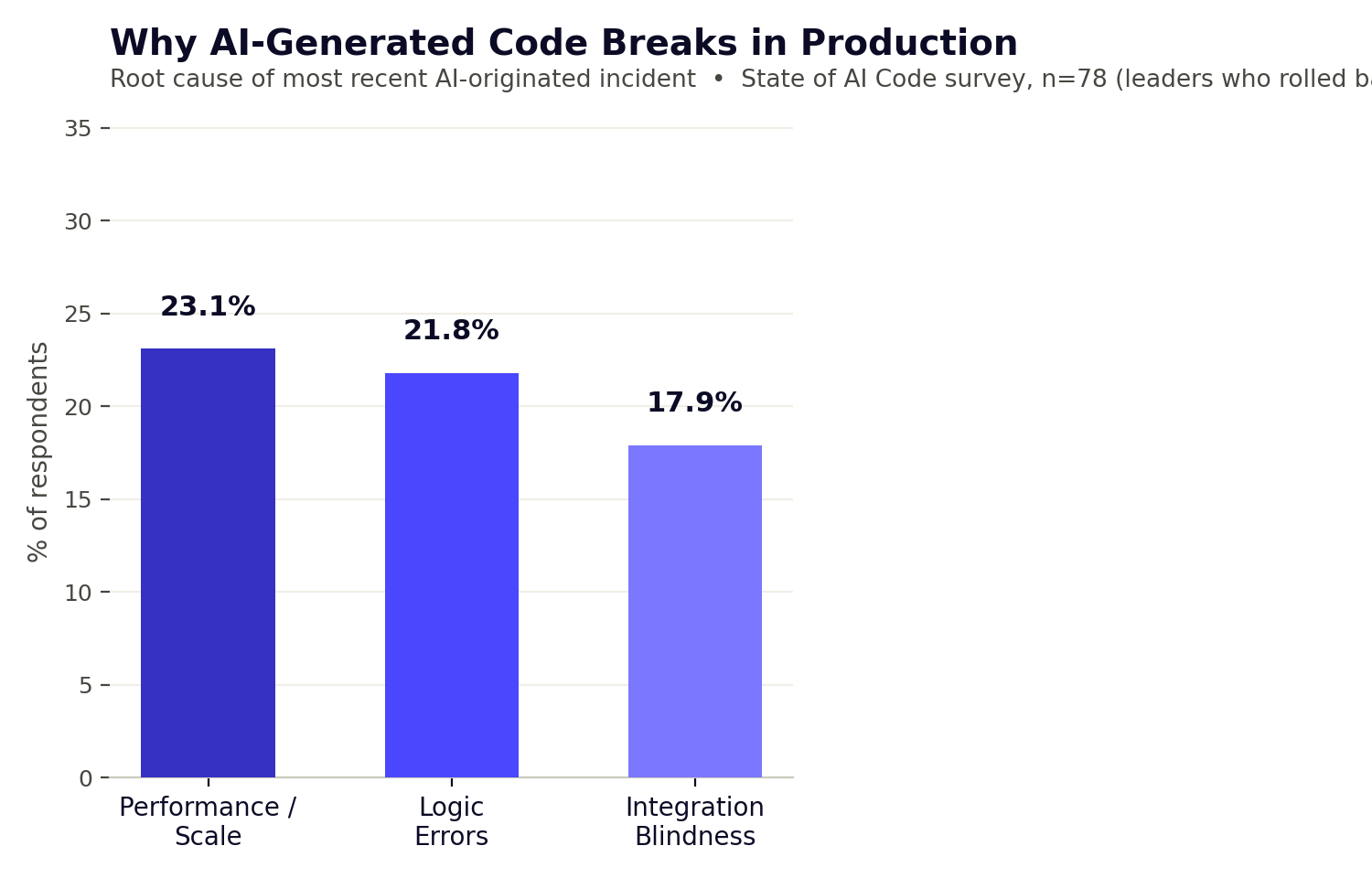
- The gap has two layers: blind code and brittle tests: Checksum's research traces AI code failures to two compounding causes: code that can't see real production conditions like API rate limits or real data shapes (23.1% of rollbacks tie to performance/scale issues, 21.8% to logic errors, 17.9% to system-interaction blindness), and test suites with a median 14.8% failure rate driven mostly by selector and environment changes rather than real bugs.
- The trust paradox has a high price tag: A team maintaining a suite of 500 tests can expect to spend around $4.3 million a year keeping that suite healthy, before counting the added cost of blocked releases, context-switching, or the support and rework hours that teams lose to AI-code issues each year.
Is headcount the fix?
Ask leaders why they haven't closed the gap between AI code generation and verification with more engineers, and only 28.6% think they could hire their way out of the review burden.
Checksum's state of code verification report shows teams lose an average of 3.2 hours between a test failure and a deploy-ready fix, versus 18 minutes when the failure is one an AI-native system resolves on its own. Teams see roughly 4.2 blocked releases a month tied to test failures, and engineers report losing 2.5 to 4 hours a day to the context-switching that comes with chasing them down.
This is compounded by the time it takes to review AI code. 64.8% of those surveyed said that AI code takes more review time than human code, not less. And so with review cycles stretching under the volume of AI code being generated, throwing more reviewers at code nobody can fully verify just adds more people to the same blind spot.
So if trust is rising, incidents are rising, and more eyes on the code isn't the fix, what's actually broken?
Two layers of the same blind spot
The answer can be explained as two problems.
Layer one: the code itself
Among leaders who've rolled back an AI change and could pin down why, no single cause dominates. Performance and scale issues that only surface under real load lead at 23.1%. Logic errors the AI wrote follow at 21.8%. And 17.9% come down to something more specific: the AI couldn't see how its code would interact with the rest of the system e.g. the database, the third-party APIs, the load, the data shapes.
One CTO in ecommerce described a version of this directly: their team shipped a discount-calculation function that passed unit testing cleanly, then failed in production because the AI hadn't accounted for the rate limits of a legacy inventory API. The failure surfaced as 20-minute checkout timeouts before anyone could roll it back.
Source: The state of code verification, 2026
Layer two: the safety net underneath it
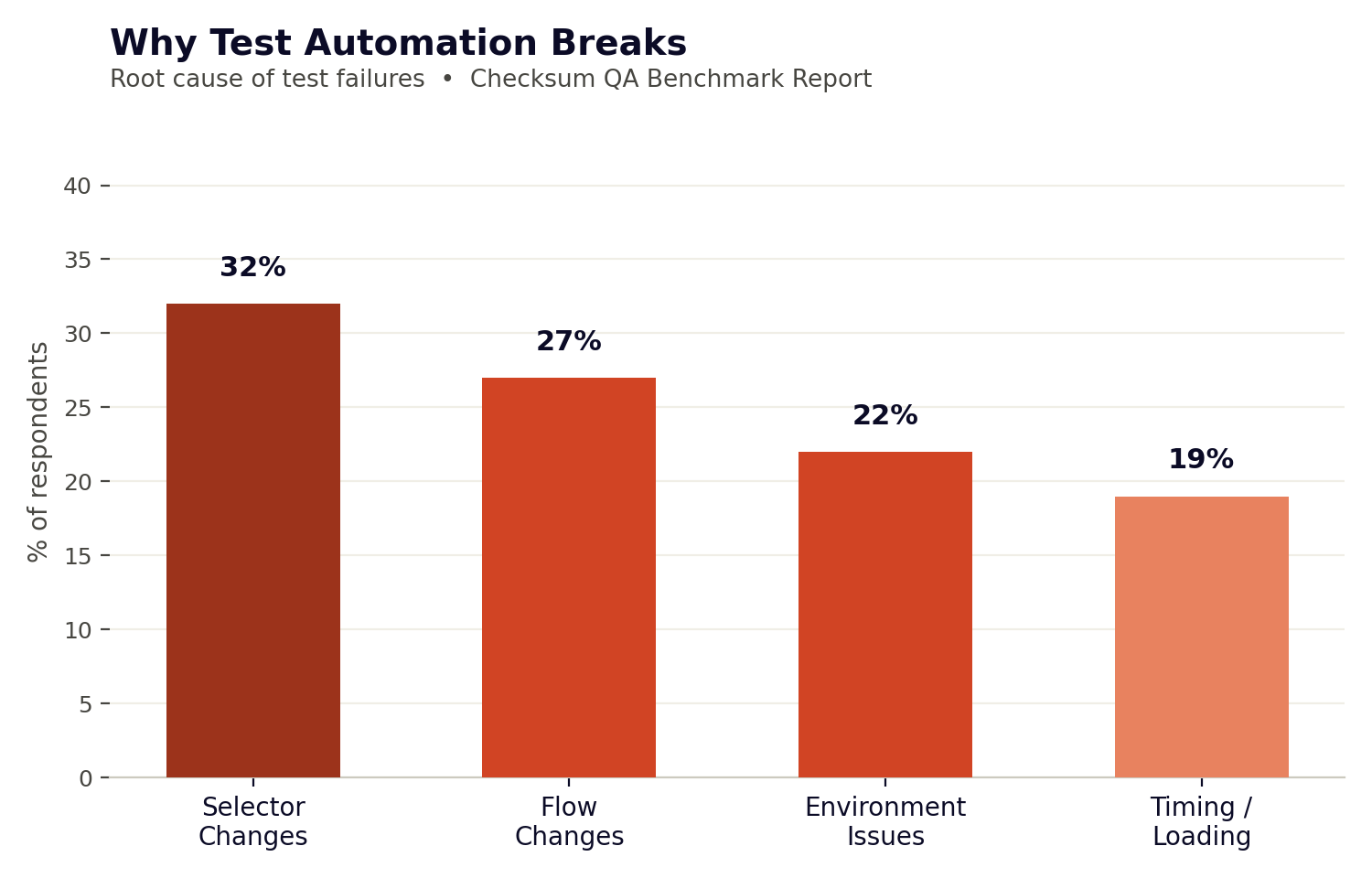
The automated tests built specifically to catch this kind of failure are themselves unreliable. Checksum's benchmark data puts the median test failure rate at 14.8% across production test suites, and the causes have nothing to do with real bugs: selector changes account for 32% of failures, flow changes 27%, environment issues 22%, and timing or loading problems 19%.
Source: The state of code verification, 2026
Teams often don't catch this sooner because standard benchmarks for AI coding and agent performance are usually quoted as a single accuracy number—usually around 85%—measured per step. That sounds solid until you consider that most real workflows chain multiple steps together. Compound 85% accuracy across ten steps and the realistic success rate falls to roughly 20%. These benchmarks lose impact when you realize they're answering a narrower question than the one teams need answered.
Put the two layers together and the picture is this: code that hasn't been verified against real conditions, wrapped in a verification layer that's too brittle to trust on its own. Neither problem is visible from the other side.
The code verification gap isn't closing
AI is now writing nearly all the code teams ship. AI verification is also widely adopted, but its application is uneven. AI unit-test generation is the most direct counterweight to AI-written code and is being used by less than 50% of those surveyed, the least adopted form of verification.
It's the same gap CI/CD left behind a decade ago. CI/CD automated how code gets to production, not what that code does once it's there. AI adoption has focused on the first half of the pipeline, increasing the amount of code generated enormously, while verification is still being patched together.
Modeling the cost of the code verification gap
The price tag is significant on its own terms. Using a blended engineer rate of $150/hour and an average fix time of 1.3 hours per test failure, a team maintaining a suite of 500 tests can expect to spend in the range of $4.3 million a year to keep that suite healthy. That’s before counting the separate cost of blocked releases, context-switching, or the trust erosion that comes with a flaky pipeline.
But it isn't the whole bill. In the last 12 months, a meaningful share of teams saw AI-code issues drive up support load directly, and a comparable share lost engineering hours to rework outside the test suite entirely. The maintenance cost above is one visible part of the iceberg, not all of it.
What changes with Checksum
Both layers of the AI code trust gap trace back to the same thing: verification that can't see what production sees. That's the specific gap Checksum is built to close.
Checksum's E2E Agent automatically generates a test suite from your actual user flows, then runs it against real data shapes and real environment behavior. Pair it with the API Agent to cover your backend directly. This is what closes layer one, the context blindness that lets AI-generated code look correct while it can’t see how the rest of the system behaves. And because the suite auto-heals as your application changes, it closes layer two as well: the brittleness that turns ordinary UI or environment changes into false failures and burned engineering hours.
The results have been benchmarked against manual and standard automated approaches: an 82% reduction in failure rate, 70% of failures resolved fully autonomously with no human involvement, and an average time-to-resolution of about 5 minutes versus 1.3 hours for manual fixes.
Closing the context gap doesn't mean trusting AI code less. It means building verification that finally operates where the failures live.
Access the full data behind this piece
- See full survey results in the State of AI code report →
- Get the cost breakdown in the State of code verification infographic →
FAQs
What is the AI code trust gap?
The AI code trust gap is the widening distance between how much engineering leaders trust AI-generated code and how well that code has been verified before it reaches production. Checksum's State of AI code report found 78.1% of leaders trust AI code more than they did a year ago, yet 61% shipped a production incident originating in AI-generated code in the last 90 days, and 74.3% have rolled back an AI change that broke in a way their unit tests never caught.
Why does AI-generated code still fail after passing code review and unit tests?
AI coding tools write code without visibility into how it will behave under production conditions: real API rate limits, real data shapes, and real load. Among leaders who rolled back an AI change and could pin down the cause, 23.1% pointed to performance or scale issues that only surfaced under real load, 21.8% to logic errors, and 17.9% to the AI's inability to anticipate how its code would interact with the rest of the system.
That's compounded by test suites with a median 14.8% failure rate, most of which trace back to flaky selectors, environment issues, or flow changes rather than actual bugs.
How does Checksum close the AI code verification gap?
Checksum's E2E Agent generates a test suite directly from a product's real user flows and runs it against real APIs, real data, and real environment behavior, then auto-heals the suite as the application changes. Benchmarked against manual and standard automated testing, this closes both layers of the gap: an 82% reduction in failure rate, 70% of failures resolved fully autonomously, and an average time-to-resolution of about 5 minutes versus roughly 1.3 hours for manual fixes.