
AI coding agents like Cursor, Claude Code, and GitHub Copilot now write a significant share of production code. They have fundamentally changed the pace of output, with 98% more pull requests per person on high AI-adoption teams, and review time up by 91%. But the way most teams verify that code has been slower to change.
AI testing is the use of machine learning and large language models (LLMs) to generate, execute, maintain, and adapt software tests with minimal human authorship. Instead of engineers writing every test case and assertion by hand, an AI testing system does that work. Crucially, it keeps doing it as the product changes.
This guide covers what AI testing is, how it differs from traditional test automation, how auto-healing works under the hood, whether you can trust it, and where a platform like Checksum fits in.
Key takeaways
- AI testing isn't AI-assisted testing. AI testing uses machine learning and LLMs to generate, execute, and maintain tests automatically. In contrast, AI-assisted testing requires a human to author every test and AI only suggests snippets or completions.
- Most test failures aren't real bugs. Around 70% of failures in fast-moving products are maintenance issues—stale selectors or changed flows, not real regressions—and auto-healing resolves them automatically without engineer intervention.
- Reliability is a property of the system, not the AI. AI-generated tests are validated against the real application, healed tests are re-run before committing, and all changes surface as PRs for human review.
What is AI testing?
AI testing is software testing that generates, executes, triages, and maintains itself using machine learning and LLMs to handle the work that engineers previously did by hand. Writing, running, and fixing tests shifts to the system. This gives engineers and QA teams time back for the things humans still do best: targeted manual testing, exploratory testing, and judgment calls.
How it differs from adjacent terms
AI-assisted testing: AI is a writing aid but humans still author the tests. For example, AI suggests a selector, autocompletes an assertion, or generates a snippet from a prompt but a human reviews and commits the test. Coverage growth is dependent on someone having the time to write tests.
Test automation: Humans write automated test scripts that run on a schedule or in CI. These are faster than manual QA but the scripts are static so every time the product changes, someone has to update them. Maintenance is not automated.
AI testing: The system generates the test, runs it, and updates it as the product evolves. Authorship and maintenance are largely automated. Coverage can grow continuously without requiring engineers to write cases by hand.
AI-assisted testing and traditional automation require engineers to stay in the loop on every test change. AI testing shifts that maintenance burden to the system, freeing humans to review outcomes rather than write tests from scratch.
What AI testing does across the test lifecycle
- Test generation: The system maps the application (screens, flows, interactions) and produces tests that reflect how the product behaves
- Execution: Tests run automatically, typically on every commit, PR, or deploy
- Failure triage: When a test fails, the system analyzes whether the product broke or the product changed
- Maintenance (auto-healing): The test updates automatically if a UI element moved, a selector changed, or a flow was reordered
Most engineering teams think about testing in layers: unit tests at the base, integration tests in the middle, and E2E tests at the top. AI testing operates primarily at the E2E and integration layers because it maps real application flows, generates tests against a running product, and maintains coverage as the UI and APIs change.
Unit tests remain essential for testing logic in isolation, but they can't see what happens when code runs against real APIs, real data, and real user flows. Think of AI testing as covering that gap: the full user journey, cross-service interactions, and real-world flows that only exist when the whole system is running together.
This is where maintenance cost bites hardest. Checksum's analysis of 1M+ production test runs found that the average team spends 1.3 engineering hours per failure, and a 500-test suite can cost the equivalent of three full-time engineers annually to keep green.
Why traditional testing can't keep up
There are three main reasons why teams are making the switch to AI testing.
The velocity issue
AI coding tools have changed the math on software output. Teams that once shipped ten PRs a week now ship twenty. However, the QA and test automation practices most teams rely on were designed for a slower, more predictable pace of work.
Traditional test automation requires a human to write every test, then another human to fix it when the product changes. The pace of AI-generated code has made that approach a bottleneck.
The maintenance spiral
Here's the failure mode most teams know well:
- A UI or flow change ships. This could be a renamed button, reordered form step, or selector change
- Existing tests break. According to Checksum research, selector changes account for roughly 32% of failures; flow changes account for another 27%
- Someone triages to find out whether it’s a real regression or a change in the product
- That triage takes time, then the fix takes more time
The result is one of two outcomes: coverage quietly shrinks as teams stop maintaining tests they don't have time to fix, or the suite runs red so often that engineers tune it out.
The adoption-verification gap
AI coding tools accelerated the write-code side of the equation without providing anything on the verify-code side. The velocity of output has outrun the velocity of verification, creating a gap.
AI testing as a category exists to close that gap, scaling verification the way code generation has scaled.
How AI testing differs from traditional test automation
This table illustrates the differences side by side:
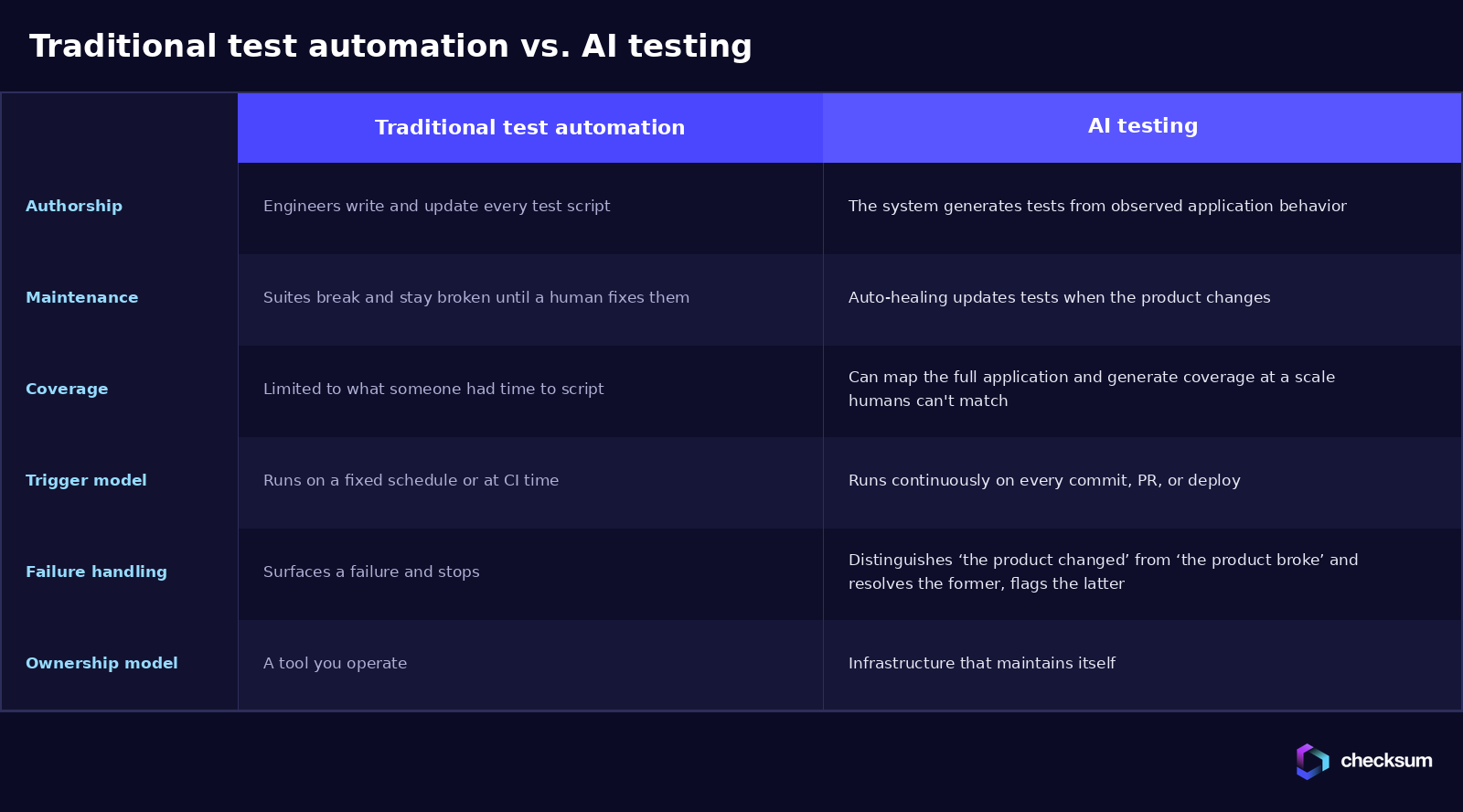
Teams with existing Cypress or Playwright suites often ask whether they need to throw away what they have to move to an AI testing system. The answer is no. AI testing can run alongside an existing suite, extending coverage where gaps exist, or it can migrate tests from one framework to another. For teams on Cypress looking to move to Playwright (a common transition as Playwright has become the default for E2E testing) migration is often the faster path than maintaining two suites in parallel.
This was the path taken by Engagement Agents. The team migrated 500 existing tests in a week and launched a major UI redesign 30% faster as a result of adopting Checksum, turning what looked like a months-long rewrite into a one-week project.
The important framing shift between traditional test automation and AI testing for engineering teams is this: by behaving more like infrastructure, AI testing stays current, resolves its own maintenance work, and keeps running whether or not an engineer is actively tending to it.
That said, AI testing doesn't replace human judgment about what to test strategically. Rather, it removes the repetitive authorship and maintenance burden so engineers can focus on the decisions that actually require judgment: what matters to test, where to draw coverage boundaries, and how to interpret outcomes.
How auto-healing tests work
Auto-healing is the mechanism that sets AI testing apart from traditional automation.
The failure mode it addresses
Most test failures in a fast-moving product turn out to be stale tests. For example, a button label changed or a modal was added to a flow. The feature works fine; the test just doesn't reflect the current state of the product.
In a traditional suite, this failure looks identical to a real regression until someone investigates.
The auto-healing mechanism
A failed test in an AI testing system triggers this sequence:
- The test runs and fails. Something in the expected flow didn't match the current application state.
- The system analyzes why. Was the underlying behavior still present in a different form? Did a selector change, a label change, a step get reordered? Or is the feature actually broken?
- If it looks like a product update, not a regression, the test is automatically updated to match the new behavior.
- The updated test runs again to confirm it still checks the intended behavior.
- The change is surfaced for human review, typically opened as a PR, rather than silently applied.
Step 5 shows the advantage for engineers adopting an AI testing system. They’re still in the loop, but time is spent reviewing outcomes rather than doing the triage and fixing work manually.
What this looks like at scale
Data from Checksum’s customers indicates that roughly 70% of test failures can resolve without a human touching them. The triage-and-fix work that previously landed on engineers is handled automatically, and the remaining 30% surface as genuine failures worth investigating.
What auto-healing doesn't do
Auto-healing resolves maintenance failures. It wasn’t designed to resolve real regressions. If the feature is actually broken (i.e. the API returns the wrong data, the flow is incomplete, or the behavior doesn't match the spec) the test fails and stays that way. That's the signal you want.
The distinction between "the app changed" and "the app broke" is the core of the auto-healing mechanism. Getting that distinction right is what makes auto-healing reliable rather than dangerous.
Code ownership
When auto-healing is done well, the result is standard and readable test code like Playwright, committed to the repo. Engineers can open the PR, read the diff, and understand exactly what changed and why. It's a pull request rather than a black box.
Is AI testing reliable?
Some developers are cautious of AI testing. They have every right to be, having been burned by flaky traditional test suites that cried wolf too often, and then again by AI output that sounded right but wasn't. The 2025 Stack Overflow Developer Survey found that more developers distrust AI accuracy (46%) than trust it (33%).
So when someone says "AI testing will generate your tests automatically," it’s natural to ask: how do I know those tests are checking the right things?
Reliability is a system property, not a single output
Reliability in AI testing isn't a property of any one generated test—it's a property of the system around it. This means:
- Generated tests are run against the real application. A test isn't assumed correct because an LLM wrote it. It's validated by running it against the product and confirming it behaves as expected.
- Auto-healing includes a verification step. A healed test is re-run before it's committed. The system checks that the updated test still verifies the intended behavior, not just that it passes.
- Human review remains. Changes are opened as PRs, not silently applied. Engineers can audit what changed, approve it, or push back. Nothing rewrites what "passing" means without a human seeing it.
- Tests are standard, inspectable code. Engineers can read exactly what's being checked. There's no proprietary black box because the tests live in the repo alongside everything else.
AI testing systems demonstrate an 82% failure rate reduction. This means the vast majority of updates that would have broken a traditional test suite are absorbed without human intervention. Using Checksum's E2E Agent, Postilize reduced bugs in production by 70%.
Ultimately, AI testing is best at scaling and maintaining coverage of flows that can be observed and executed. It's not a substitute for exploratory testing, security testing, or the kind of strategic test planning that requires understanding business risk and user behavior in ways that can't be inferred from a running application.
Reliability comes from pairing AI testing with human oversight—not from replacing human oversight with it.
Where tools like Checksum fit
Checksum's E2E Agent is a concrete example of AI testing built on the principles described above.
The E2E Agent starts by mapping the full application—every screen, flow, and interaction. From that map, it generates production-ready Playwright tests and commits them directly to the repo. There’s no proprietary format or vendor lock-in. The tests are standard Playwright code that engineers can read, modify, and own.
As the product changes, the E2E Agent auto-heals broken tests and opens PRs for review. Tests don't go stale; the suite doesn't drift from the product. Coverage stays current without requiring engineers to triage and fix tests manually.
And it runs continuously. This is the layer beyond CI/CD. While CI tells you if the build passed, continuous verification tells you if the product still does what it's supposed to do every time something ships.
In practice: Söderberg & Partners saved 90 hours of manual testing per month and caught zero issues missed by Checksum after deploying the E2E Agent. Clearpoint Strategy built over 250 E2E tests in under a month, coverage that would have taken a team months to author manually.
Closing the gap between AI development and verification
AI testing is an emerging category that shifts testing from something engineers author and maintain by hand to something that generates and maintains itself.
CI/CD got code out the door faster. AI testing keeps the quality signal trustworthy as that pace increases. Together, they're what a modern engineering team's verification stack should look like. Don't stop at CI/CD. Ship faster with continuous verification.
If you want to see what this looks like for your product, book a demo.
FAQs
What is AI testing?
AI testing is the use of machine learning and large language models (LLMs) to generate, execute, maintain, and adapt software tests with minimal human authorship. Unlike traditional test automation, where engineers write and maintain every test by hand, an AI testing system handles those tasks automatically. It generates tests from observed application behavior, runs them continuously, and updates them when the product changes.
How is AI testing different from test automation?
Traditional test automation requires engineers to write every test script and fix it when the product changes. AI testing generates tests automatically from how the application actually behaves. This includes auto-healing, so tests update themselves when UI elements, selectors, or flows change. The key difference is that while automation is a tool you operate; AI testing behaves like infrastructure that maintains itself.
What does "auto-healing" mean in testing?
Auto-healing (sometimes called self-healing in other tools) refers to a test system's ability to detect when a test has failed because the product changed (not because the product broke) and automatically update the test to match the new behavior. Rather than surfacing the failure for a human to investigate and fix, the system resolves it, runs the updated test to confirm it's still checking the right thing, and opens a PR for human review. Roughly 70% of test failures can be resolved this way without manual intervention.
Can I trust AI testing?
Yes, when implemented with the right safeguards. The key is that reliability is a system property, not a property of any single AI output. Well-designed AI testing systems:
- Run generated tests against the real application before committing them
- Include a verification step in auto-healing
- Surface changes for human review via PRs rather than applying them silently
- Produce standard inspectable code rather than a proprietary black box
Do I still need a QA team if I use AI testing?
Yes. AI testing removes the repetitive authorship and maintenance burden on QA teams, but it doesn't replace strategic thinking about what to test, exploratory testing, security testing, or the judgment calls that require understanding business risk and user behavior. Less QA time is spent fixing broken selectors and triaging stale tests, and more time is spent on the work that actually requires human expertise.
What tools are used for AI testing?
AI testing tools typically focus on one or more layers of the test lifecycle: generation, execution, auto-healing, and reporting. Checksum's E2E Agent covers the full lifecycle for end-to-end UI testing, generating Playwright tests, running them continuously, and auto-healing them as the product evolves. Other tools in the space include Playwright (as a framework, not an AI testing platform), Mabl, and Testim. When evaluating a tool, look out for these key features:
- Whether tests are generated in standard, inspectable code
- Whether auto-healing includes a verification step
- Whether the tool runs continuously or only at scheduled intervals