
Everyone selling something has a version of it right now. It’s a tempting pitch that goes something like this:
“Give us your API spec. Our AI will write you a complete test suite. In minutes.”
On paper it's irresistible. APIs are well-defined. Test code is structured. Language models are good at reading specs and emitting code. Put them together and you should get a full regression suite while you fetch coffee.
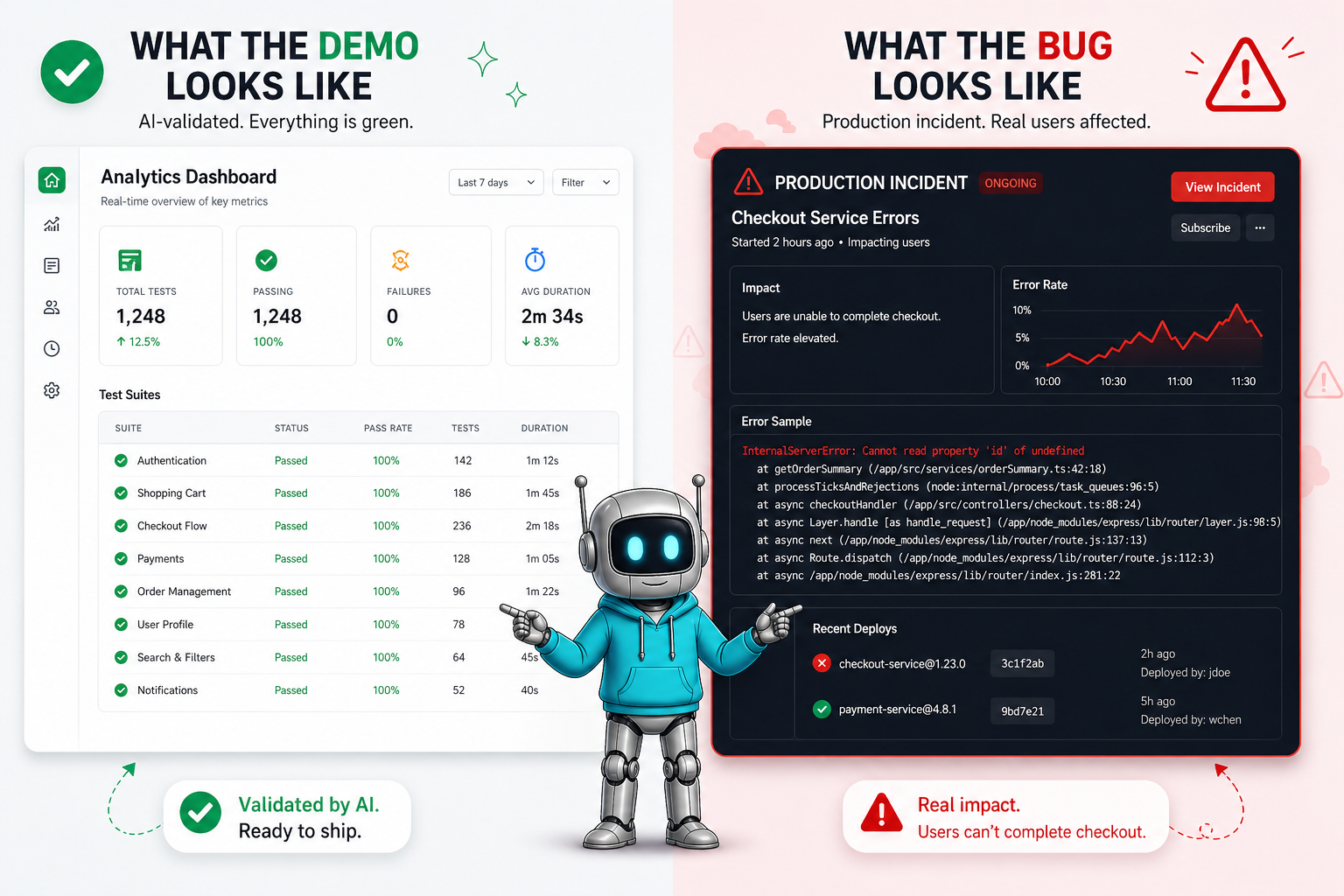
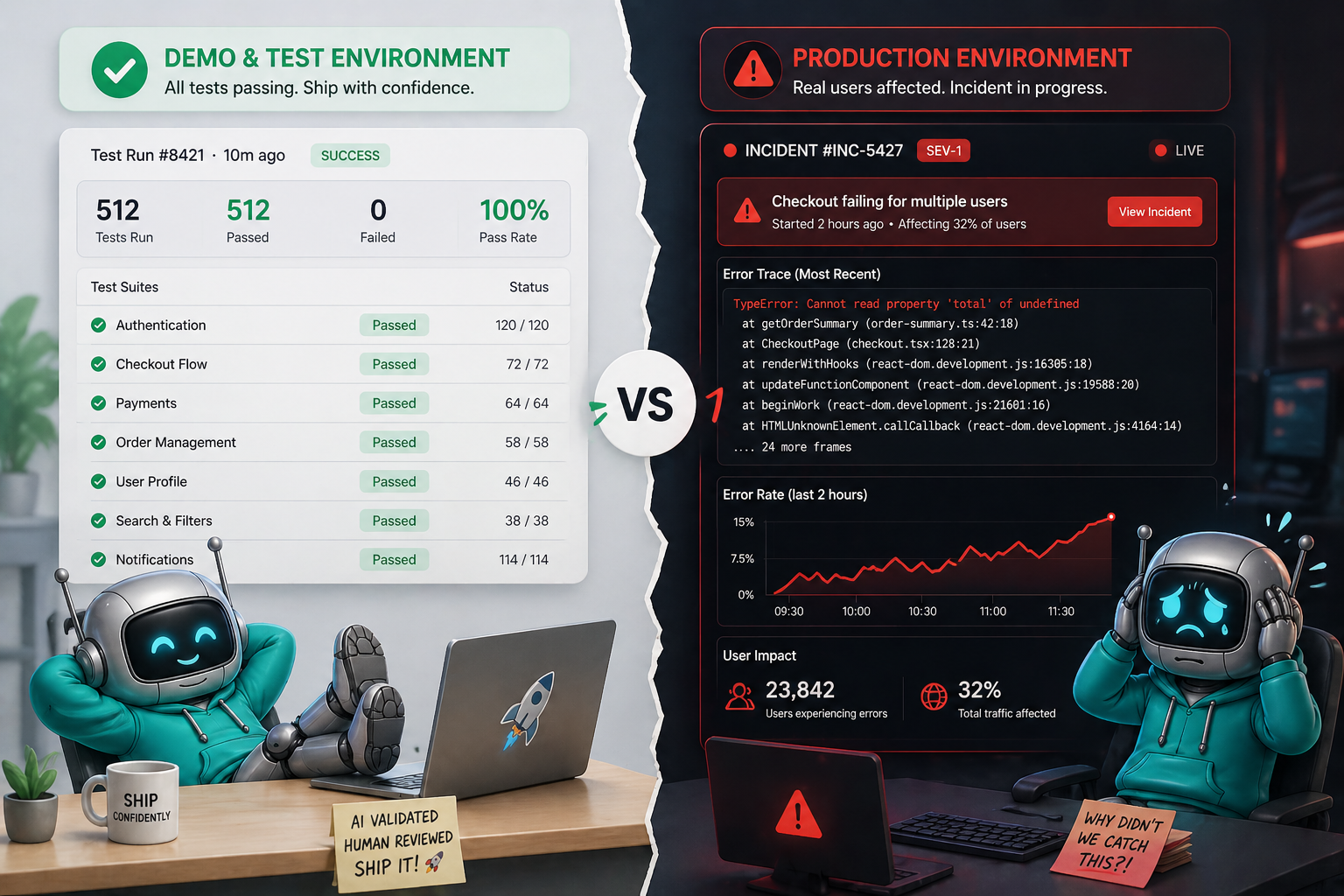
And here's the thing, the demo works. You'll see a clean UI, a spinning progress bar, and a folder of passing tests at the end. Everything will go green. You'll nod.
Then you'll ship a broken release and wonder why the suite didn't catch it.
That happens for a reason, and it's not the model's fault. Testing is a surprisingly difficult discipline, and AI doesn't replace that difficulty, it just moves it somewhere most teams don't look.
Key takeaways
- Passing and catching a bug aren't the same goal. An AI model optimizing to produce a passing test suite will quietly retreat from the hard cases and still label the result a happy path. This is the ‘proposed-to-shipped gap’, and it's invisible unless something is built specifically to surface it.
- Auth needs its own dedicated test suite, not a status-code check. Because roughly a third of production API failures are authentication- or authorization-related, an API spec only tells a generator the shape of a successful request, not the shape of its failure. Effective testing has to be engineered in deliberately.
- A test that can't pass should ship as a visible gap, not disappear. When a generated test can't be made to pass cleanly the right move is to ship it as a declared, skipped test with a human-readable reason and a specific next step. A failure that's silently filtered out becomes invisible rot in the suite.
What a naive AI test suite actually looks like
If you quietly audit what comes out of a first-gen AI test generator, you tend to find the same pattern: the tests are technically correct, they pass on every run, and they prove almost nothing.
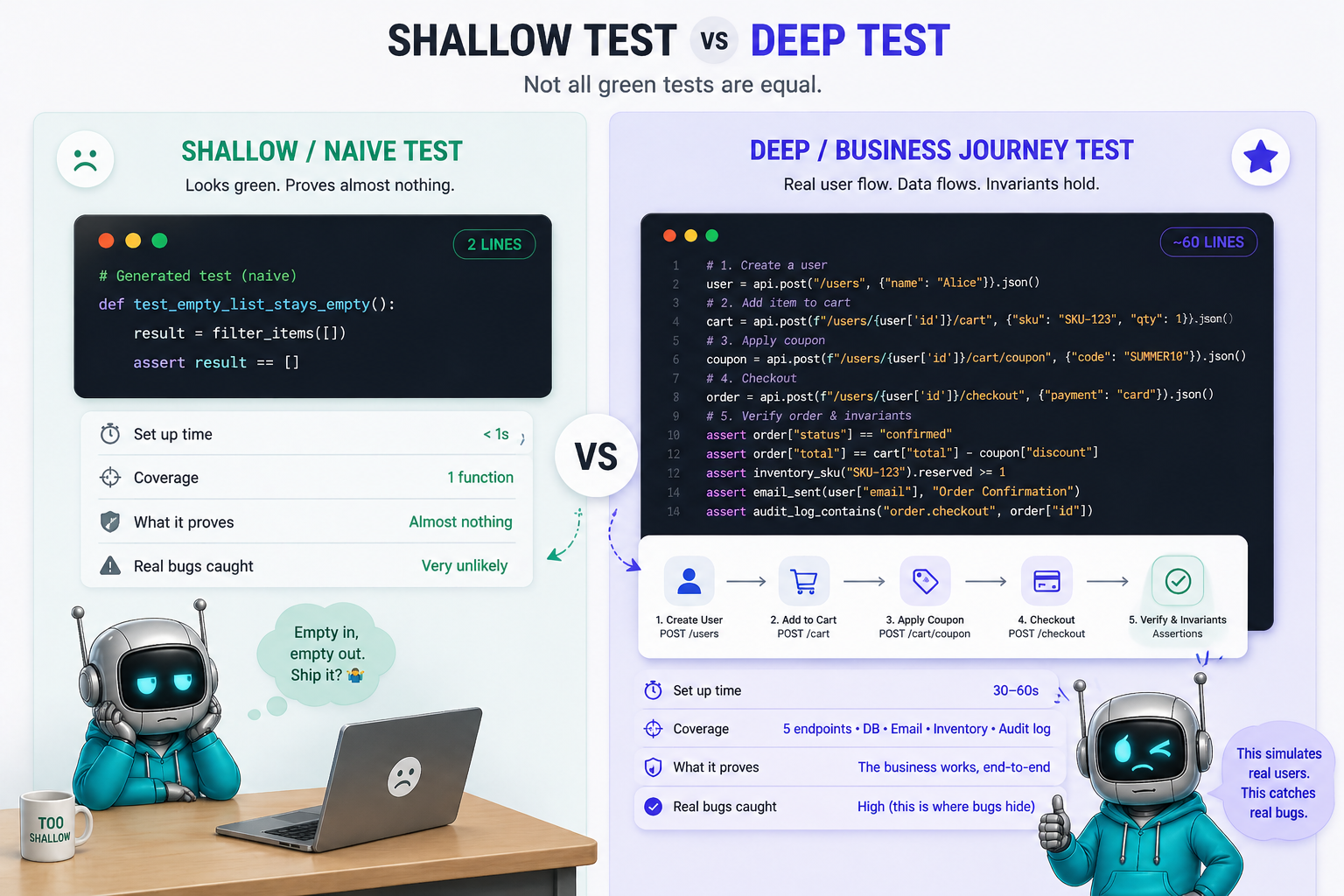
A typical ‘happy path’ test looks like this in prose:
- Call a list endpoint.
- Check that the list comes back.
- Check that the list is the same length it was before.
That's not a test. That's a ping. It will pass whether the underlying feature works or is completely broken, because the feature was never exercised.
A typical ‘sad path’ test looks like:
- Send something invalid.
- Check that the server returns a 400.
- Call the list endpoint again and verify nothing changed.
Also not really a test. Almost any server will return 400 for obviously malformed input. The important question—does the server correctly reject a valid-looking but business-rule-violating request?—is not being asked.
The missing tests are the ones that matter:
- Creation, update, and deletion actually working end-to-end. The test calls the create endpoint, then the read endpoint, and asserts that the thing it created actually exists with the data it sent.
- Auth boundaries. Who can see what? Who can do what? Whether an unauthenticated request leaks data. Whether one tenant can read another tenant's records.
- Business invariants. End dates can't precede start dates. Totals must equal the sum of their parts. An order in ‘cancelled’ state cannot be shipped.
- Idempotency and concurrency. Two identical requests produce one record, not two. A race condition doesn't silently corrupt state.
None of those show up for free. An AI left to its own devices will systematically skip them, because each one is harder to generate, harder to make pass, and easier to drop quietly when it fails.
For the industry data behind why this pattern is so common across the category, and a closer look at what generation tools produce today, see Why AI-generated API tests pass and catch nothing.
Why the AI ‘skips’ the hard tests
This is the part nobody says out loud.
Generating a test that passes and generating a test that catches a bug are two different goals. They frequently conflict. A brittle, creative, multi-step test that exercises real business logic has a much higher chance of failing on the first try because of missing fixtures, missing cleanup helpers, missing second-tenant credentials, or a hundred small infrastructure gaps.
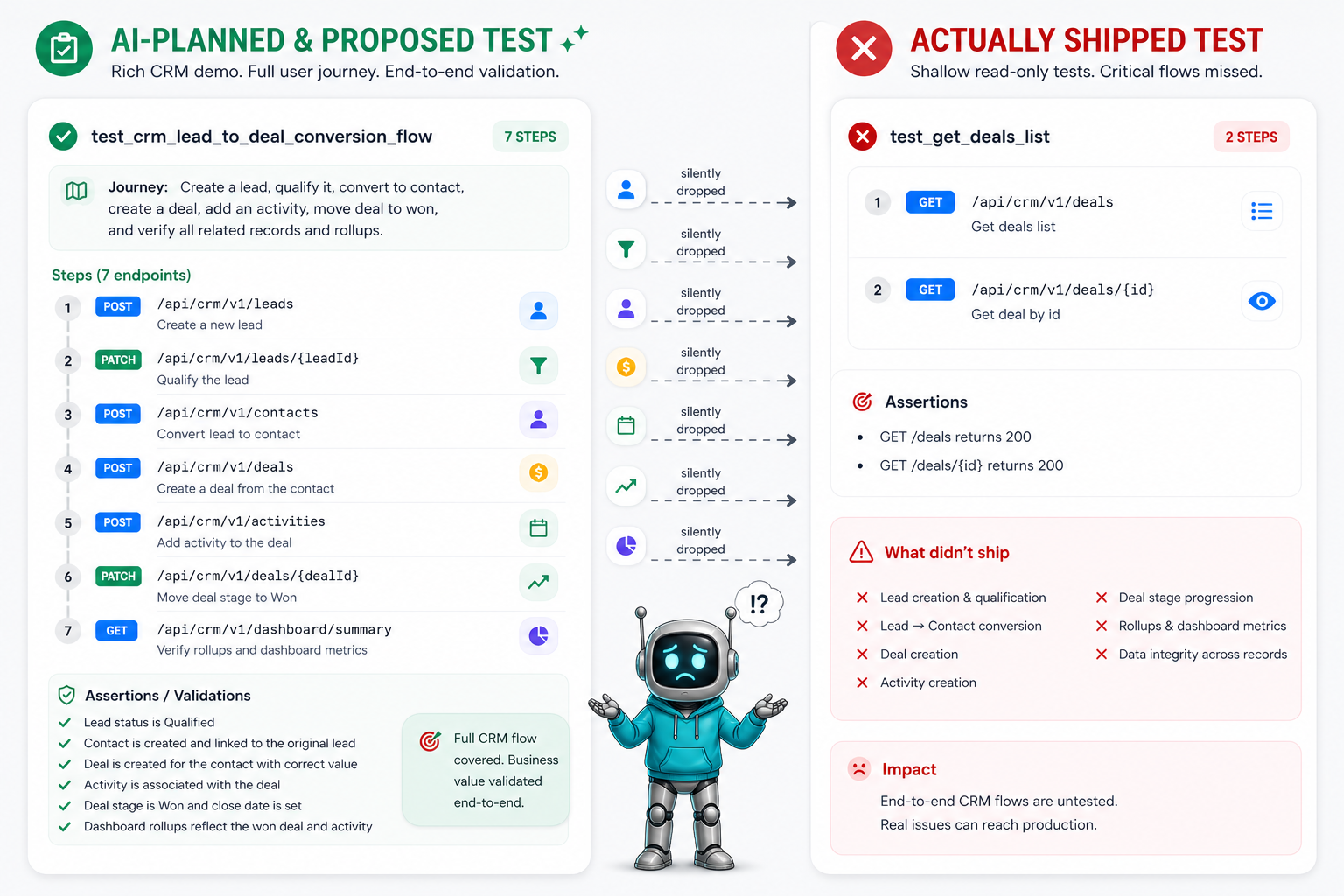
An AI model optimizing for "produce passing test code" will quietly retreat. It will shrink a five-endpoint journey to two endpoints. It will turn a mutation test into a read-only test. It will drop the cross-tenant check because there's only one credential in the environment. It will call the result a ‘happy path’.
You won't see any of this in the final output. You'll see a clean manifest of passing tests. The gap between what the AI proposed and what it shipped is invisible unless you specifically build instrumentation to surface it.
This is what we call, internally, the proposed-to-shipped gap. It is the single most important problem in agentic API testing, and no amount of prompt engineering makes it go away on its own. Prompt engineering determines what the model tries. It doesn't determine what survives the review loop.
The finesse layer
Making AI-generated API tests catch real bugs is a platform problem dressed up as an AI problem. The model is the easy part. The hard parts sit around it.
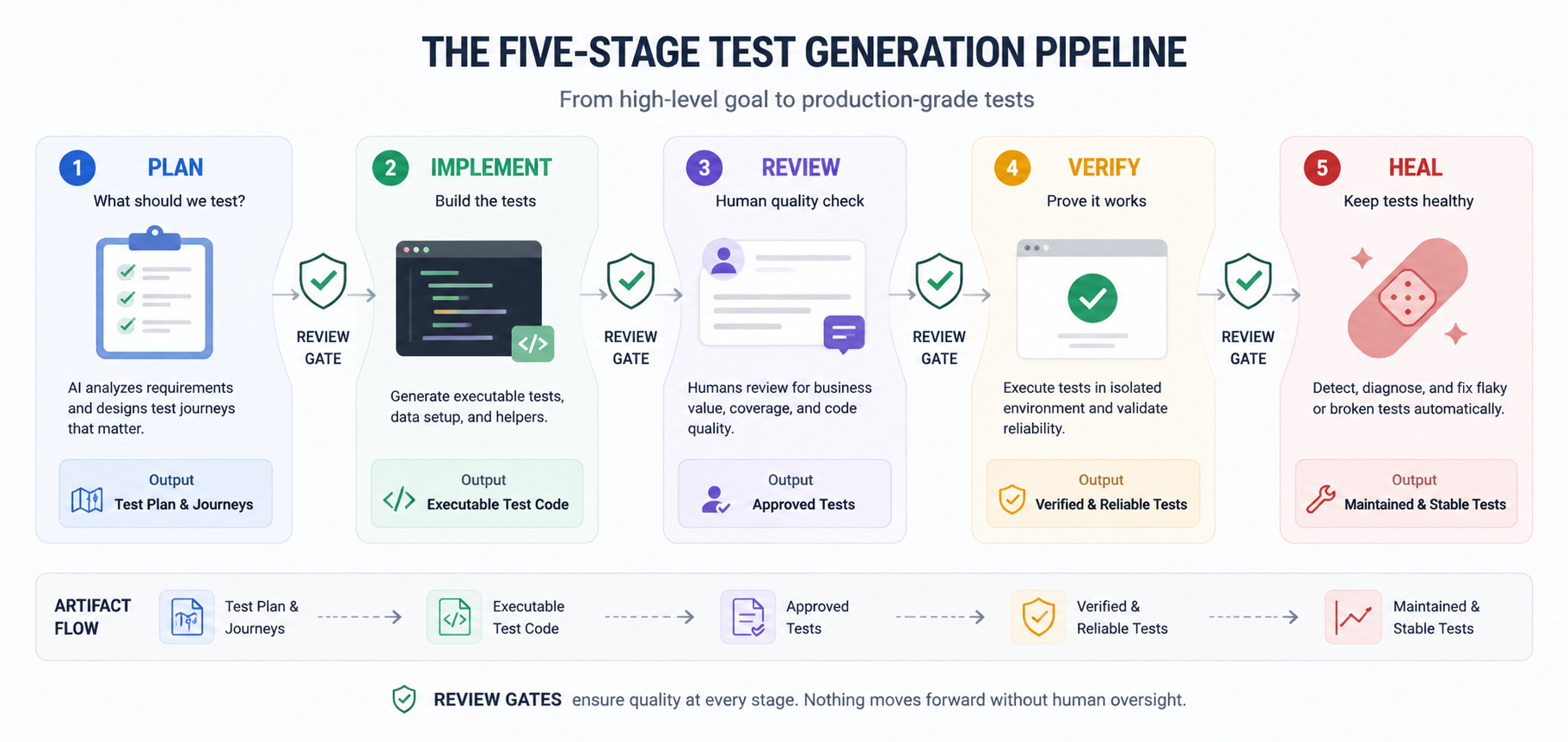
Good AI test generation isn't one prompt. It's a pipeline of specialized roles that check each other:
- A planner that reads the spec and proposes business journeys (not endpoint checks).
- An implementer that writes the actual code for those journeys.
- A reviewer that audits the code against the plan (did the implementer actually ship what was proposed?).
- A verifier that runs the tests deterministically, not in an agent sandbox where results drift.
- A healer that only gets involved in failure, with narrow context, and doesn't rewrite the world.
Skipping any stage reintroduces the proposed-to-shipped gap somewhere.
Capability suites, not endpoint checks
A test suite organized by endpoint produces one test per endpoint and learns nothing about the business. A test suite organized by capability—"Onboarding a new customer," "Running a quote through the full lifecycle," "Sharing a document across tenants"—forces the AI to chain multiple endpoints into realistic journeys, with data flowing from one step to the next.
This is the difference between a suite that proves your API returns 200s and a suite that proves your product works.
Shipping the failures, not hiding them
When a test can't be made to pass cleanly (missing credential, missing test data, platform quirk) the answer is not to silently drop it. The answer is to ship it as a declared, skipped test with a human-readable reason and a specific next step ("add SECOND_TENANT_API_KEY to your environment"). Failures that are visible are fixable. Failures that are filtered become invisible rot.
This sounds mundane but it is the single most consequential design decision in the whole pipeline.
A coverage matrix, not a test count
“We generated 437 tests” is a vanity number. It tells you nothing about quality.
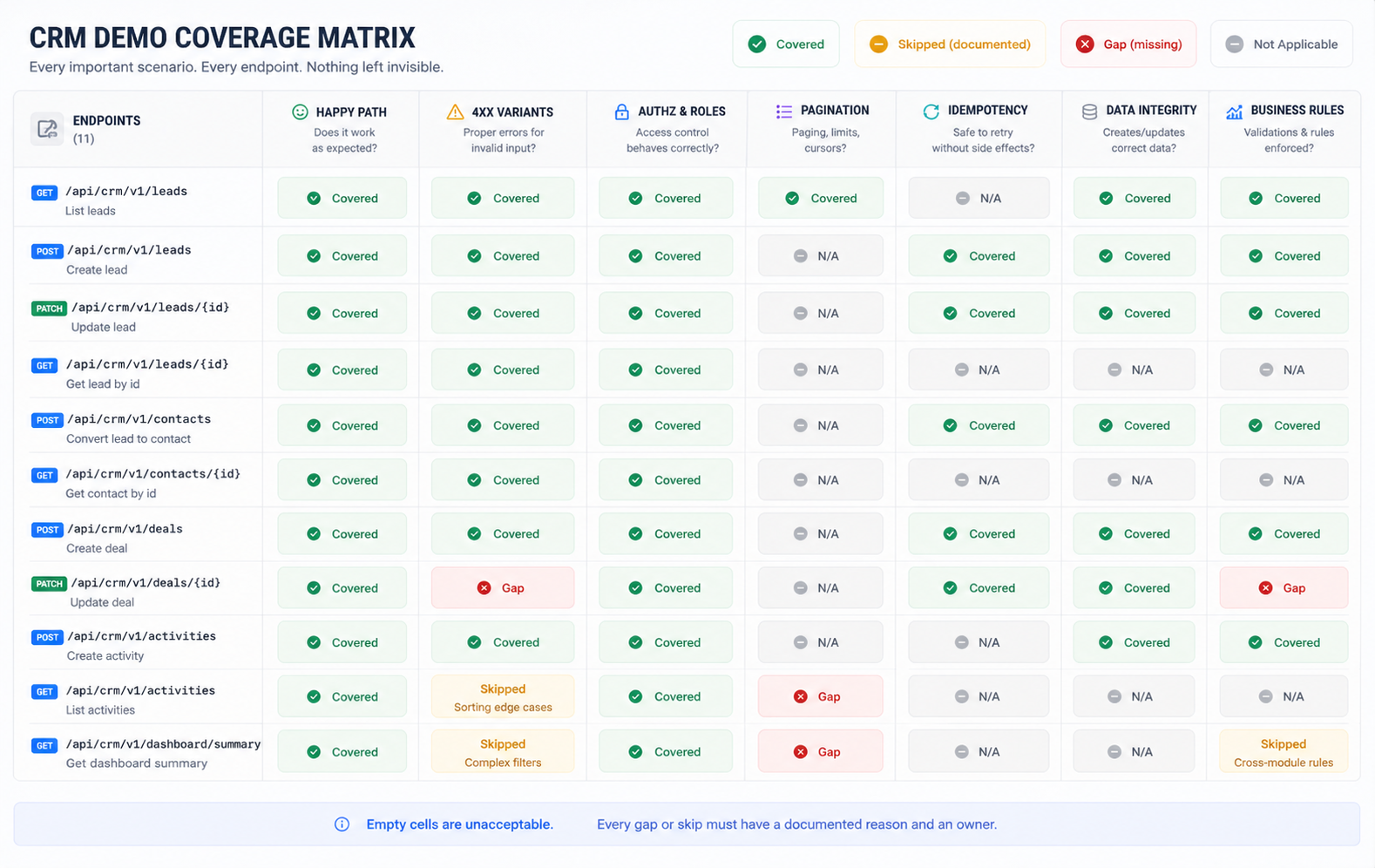
The real question is a matrix: every endpoint × every declared failure mode × every auth mechanism × every cross-cutting concern (pagination, idempotency, concurrency). Each cell is either covered by a specific test, or explicitly not covered for a documented reason. Customers should be able to look at this matrix and challenge it. “Why is cross-tenant access on the admin endpoints not covered?” is a conversation; “we have 437 tests” is not.
If you’re putting together vendor evaluation questions, we’ve also written a shorter checklist: What to ask an API test generation tool before you trust it.
Auth as a first-class dimension
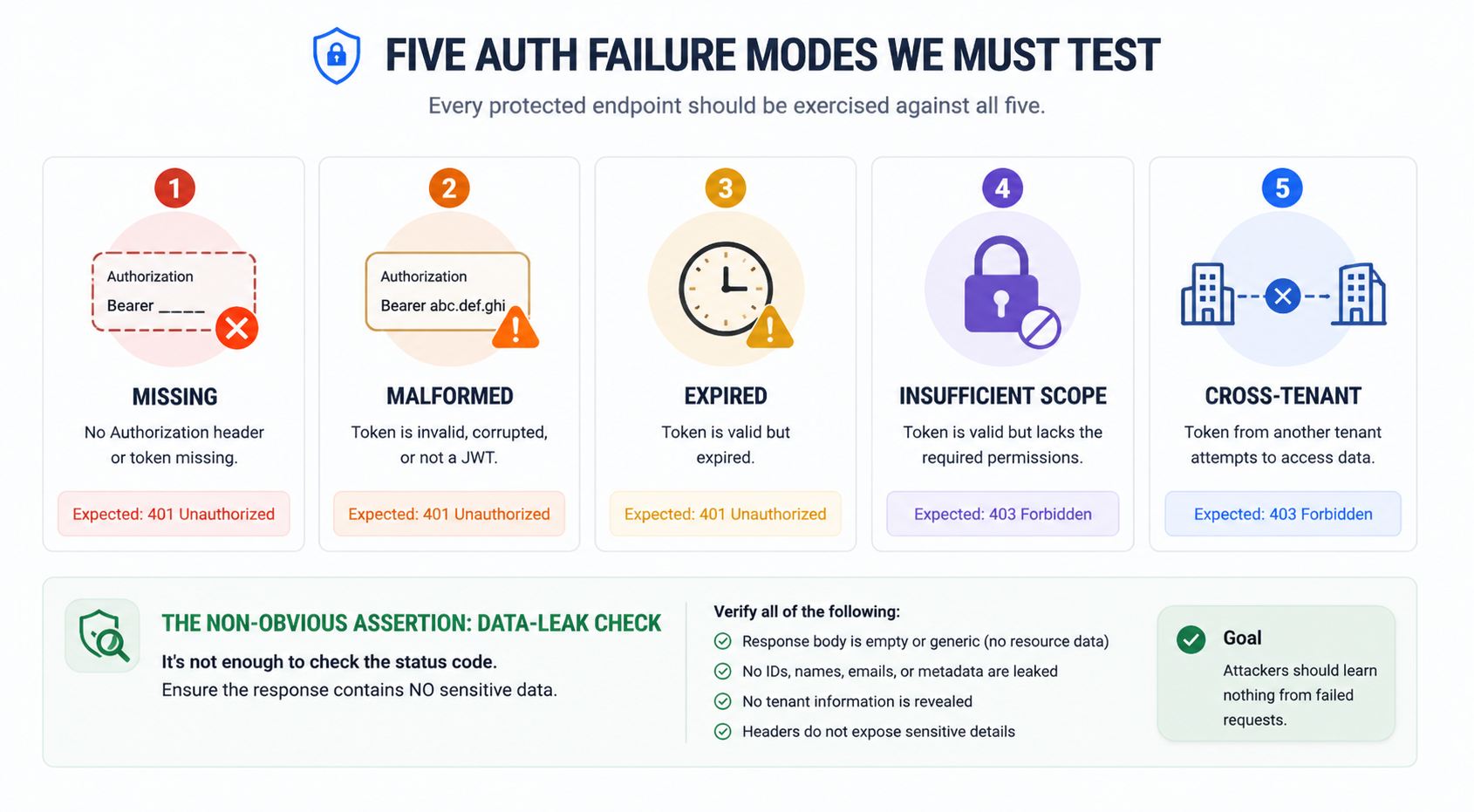
Industry data and our own findings converge here: roughly a third of production API failures are authentication- or authorization-related. A naive AI will not test authentication well, because the spec only tells it the required shape (“send a Bearer token”) and not the shape of failure (missing, malformed, expired, insufficient scope, cross-tenant, data-leaking-on-401).
This has to be engineered in. Every auth mechanism declared in the spec needs a dedicated suite of failure tests. Every one of those tests needs to assert not just the status code but the payload because the most common real-world auth bug is a 401 response that still leaks the data the caller wasn't allowed to read.
Deterministic execution
If the tests are running inside an agent session, one where retries, LLM output, and model variance can affect the run, the tests are flaky by construction. Flaky tests train teams to ignore failures. The executor should be a lightweight, deterministic runner. The AI should only be invoked when something actually fails and needs to be explained.
Assertions that mean something
Most auto-generated assertions are “status code was 200” or “the field I sent back matches the field I sent in”. They catch almost nothing.
Assertions that matter are the ones that check structure: the full response envelope conforms to the declared schema, every required field is present, no unexpected fields have leaked in. And the ones that check invariants: a computed total equals the sum of its parts, a created record has consistent timestamps, an ID never mutates after creation. These catch real regressions. A generator that doesn't default to them is generating shallow tests no matter how many.
The product is the process
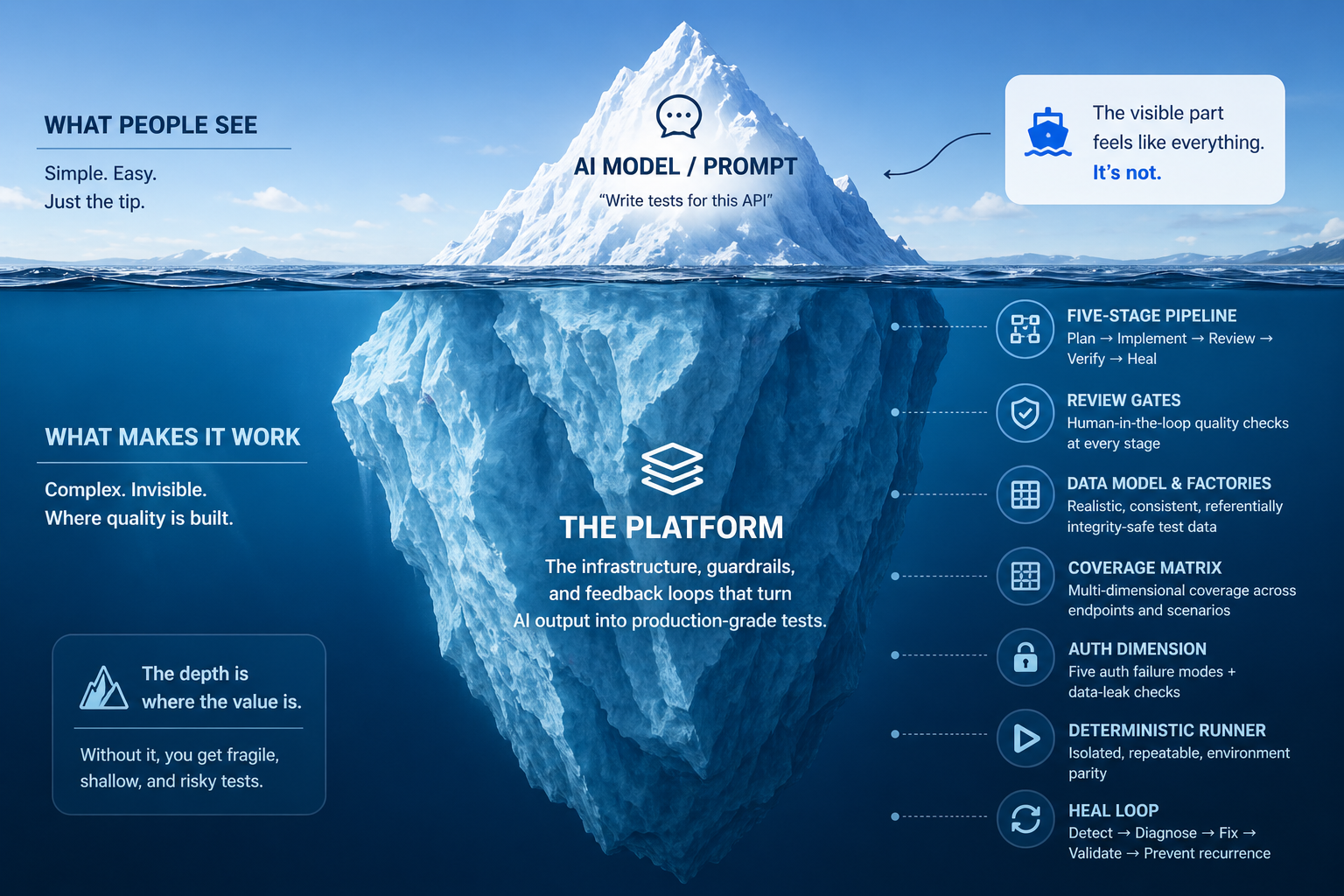
Here is the honest version of what it takes to make AI API testing work at production scale:
- A five-stage pipeline with review gates between every stage.
- A data model that tracks a test through plan → implementation → execution → heal, with first-class vocabulary for each outcome (HEALING, HEALED, SKIPPED, BUG, NEEDS_ATTENTION).
- A coverage matrix that makes what is not tested a visible, challengeable artifact.
- Prompt contracts that force tests into a seven-part structure: purpose, preconditions, action, postconditions, side-effect checks, cleanup, skip conditions.
- Guardrails that refuse to start a generation run when the inputs are missing or degenerate.
- A deterministic executor that isolates test running from test reasoning.
- An auth-boundary dimension built into the planner, not left to chance.
- A heal loop that narrows context to the failure and refuses to rewrite the suite out from under you.
None of that is prompt engineering; it is platform engineering. The LLM is a capable collaborator inside that platform but the platform is what turns “we generated tests in four minutes” into “we generated tests in four minutes AND they catch real bugs”.
Why Checksum
The reason Checksum leads the field in API test generation isn't a better model. Everyone has access to the same models. It's that we've been building the platform around the model for years, and the last few months have been an explicit, focused effort to close every remaining gap where the AI could quietly retreat to something easy.
Every lever above is live in our product:
- The pipeline is five stages, with review gates that fail runs when the implementer drops tests the planner proposed.
- Failed tests stick around as first-class SKIPPED entries with actionable reasons; there is no silent filtering.
- The coverage matrix is a real data structure exposed in the UI, not a marketing claim.
- Auth-boundary suites are generated for every declared mechanism, with five canonical failure tests and explicit data-leak assertions.
- Execution runs in a deterministic sandbox. The AI is only invoked when something legitimately needs human-like reasoning, typically healing a genuinely broken test after a spec change.
- The planner thinks in business capabilities and multi-endpoint journeys, never in ‘one test per endpoint.
None of this is the kind of thing you can demo in four minutes, but it’s the difference between a test suite that passes and a test suite that protects you.
Ask for the test that didn’t pass
If someone shows you an AI test generator and the pitch is “point it at your spec and get a suite,” ask one question:
“Show me a test that you proposed and couldn't pass. How does it appear in the final output?”
If the answer is “it doesn't, we filter those,” you're looking at a tool that optimizes for a clean demo. If the answer is “it ships as a skipped test with a specific reason and a next step,” you're looking at a tool that optimizes for detecting bugs.
The difference between those two tools is not the model. The model is the same. The difference is everything built around it, and that's the work we've spent years doing.
That's what makes AI API testing our job, not Claude's.
FAQs
What is the ‘proposed-to-shipped gap’ in AI-generated API testing?
It's the difference between the ambitious test an AI model proposes and the simplified version it actually ships once it starts optimizing for a passing result. Left unchecked, a model will quietly shrink a multi-step business journey, skip a cross-tenant check, or turn a mutation test into a read-only one. The result becomes a normal "happy path" test, with no visible trace of what was cut along the way.
Why do AI-generated tests often miss authentication and authorization bugs?
An API spec typically documents only the shape of a successful auth request (for example, "send a Bearer token"), not the shape of its failure. Since auth-related issues account for roughly a third of production API failures, catching them requires a dedicated suite for every declared auth mechanism—testing missing, malformed, expired, insufficient-scope, and cross-tenant scenarios, and confirming that a 401 response doesn't leak the data it was meant to deny.
What should an API test generation tool do with a test it can't make pass?
It should ship the test as a declared, skipped entry with a human-readable reason and a concrete next step. Filtered failures disappear; declared failures stay visible and fixable. This is also a fast way to evaluate a vendor: ask them to show you a test they proposed and couldn't pass, and see whether it's hidden or shipped.