
Quick answer: AI software testing tools use AI agents to generate, run, and maintain tests with far less manual effort than hand-written suites. The first generation could spit out tests but couldn't keep them alive, so teams drowned in flaky, brittle assertions. The version that works in 2026 is continuous: it runs in your CI/CD pipeline, heals tests when the app changes, and keeps coverage in step with how fast you ship.
Most engineering teams adopted AI coding assistants for one reason. They wanted to ship faster. And they did. In a 2025 Harness study of 900 engineering organizations, 63% reported shipping code faster after adopting AI coding tools.
Then the bill came due. The same study found that 72% of those teams had already had at least one production incident caused by AI-generated code, and 45% of deployments involving AI code led to problems. Faros AI looked at more than 10,000 developers and found teams with high AI adoption merged 98% more PRs while review time climbed 91% and DORA metrics stayed flat.
That is the paradox. You gave developers a tool that writes code in seconds, and the work of confirming that code actually does what it should never sped up to match. The bottleneck didn't disappear. It moved downstream, from writing code to verifying it, and that part is still painfully manual.
This is the gap AI software testing tools are supposed to close. Some of them do. A lot of them made it worse.
What AI software testing tools actually are
An AI software testing tool uses AI to handle the parts of testing engineers hate: writing test cases, running them, and fixing them when the application changes. Instead of an engineer hand-coding every selector and assertion, the tool reads your app, your code, or your real user behavior and produces tests from that understanding.
That is the category in one sentence. The interesting question is not what they are. It is why the first wave of them failed, and what the second wave does differently.
Why the first generation broke
The category has a credibility problem, and it earned it.
Early AI testing tools optimized for the demo. Point them at an app, watch hundreds of tests appear, ship a press release. The problem showed up three weeks later, when the UI changed and every one of those tests went red. A selector moved. A flow shifted. The suite filled with failures that had nothing to do with real bugs, and engineers spent their sprints deleting flaky assertions instead of building features.
Test maintenance already eats an estimated 30 to 40% of QA engineering budgets in large organizations. A tool that generates 10,000 tests and then leaves you to maintain them by hand hasn't solved your problem. It has scaled it.
So the bar moved. Generating tests is table stakes now. The hard part, the part that decides whether a tool is worth running, is whether it can keep those tests true as your product changes. Maintenance is the whole game.
What continuous quality looks like
The approach that holds up treats testing as something that runs continuously alongside your code, not a gate you hit at the end. At Checksum we build this as a continuous quality platform: a layer of AI agents that runs your code before it reaches production, testing against real APIs, real data, and real edge cases.
That last part is the piece most tools miss. The bugs that survive code review almost always live in the space between systems, in how your code touches your database, your APIs, and real user behavior. That space is invisible to your coding agent and invisible to a normal test suite. It only shows up when something breaks in production. Checksum's Code World Model simulates your full production environment so that space becomes visible before you ship, not after.
Two specialized agents run on top of that model, and each one creates production-ready Playwright tests that heal themselves when your app changes.
The End-to-End agent generates Playwright tests for full user journeys, then automatically repairs them when the UI evolves and selectors or flows shift. The tests ship as code in your repo, so you review them like any other change and own them outright. No vendor lock-in. If you stop using Checksum tomorrow, your suite stays exactly where it is.
The API agent covers thousands of endpoints in days rather than months, testing flows that span multiple endpoints to confirm the system actually works, not just that it returns a 200.
Underneath all three, the platform stays on. It runs on every commit, monitors production errors, and turns each new bug into a test, so coverage compounds the longer it runs. About 70% of failures resolve autonomously, with no engineer touching them.
There's also a delivery choice worth knowing about. Checksum's Results as a Service model puts a human engineer on final verification, so what lands in your repo is 100% working Playwright tests rather than AI output you have to vet. Pricing tracks the number of workflows Checksum maintains for you. No per-seat fees, no per-run charges.
How the approaches compare
Most teams are choosing between four options. Here's the honest version of what each one gives you.
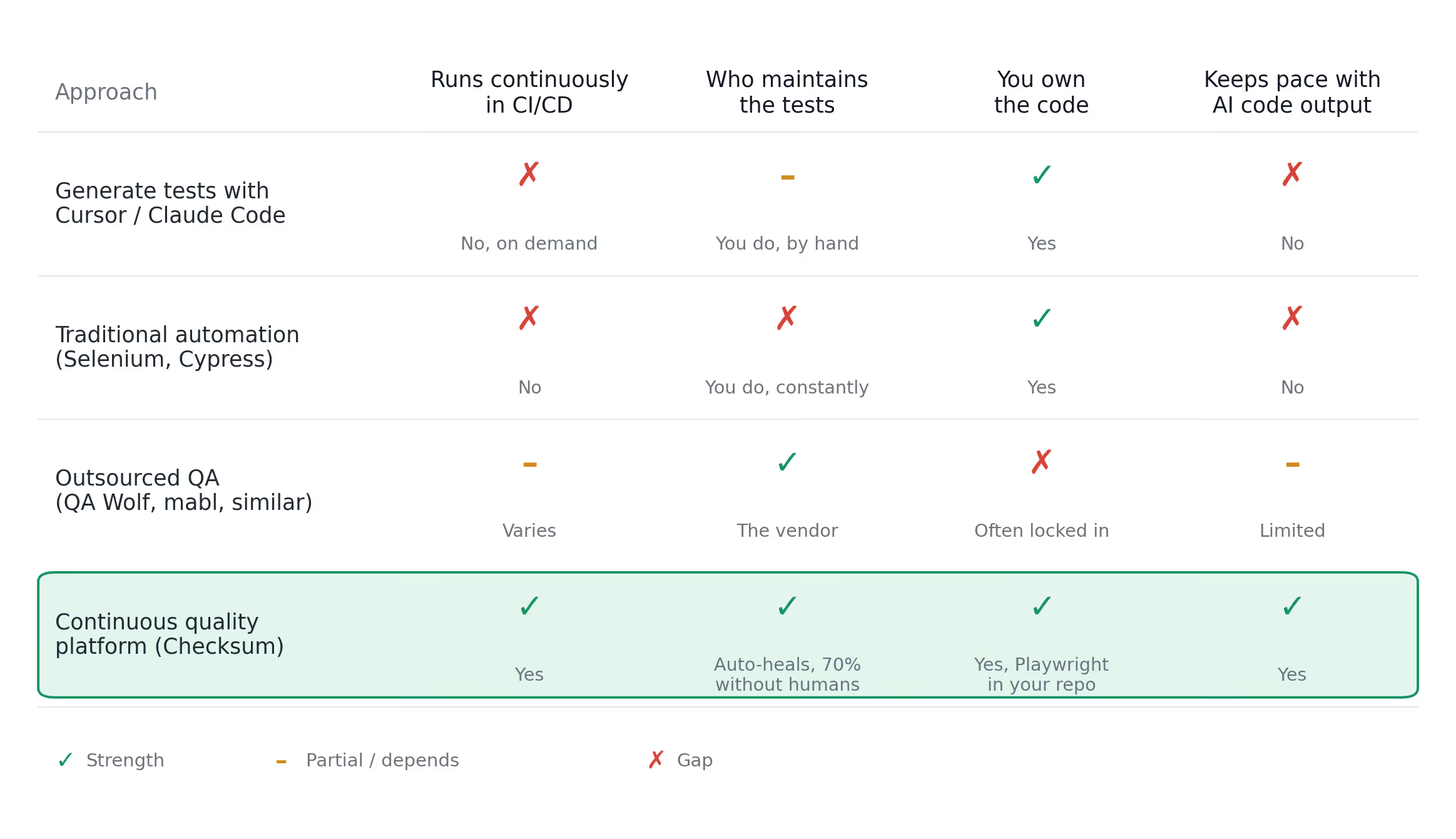
The two columns that decide it are maintenance and ownership. A coding agent can generate a test, but it hands the upkeep back to you. A traditional suite is yours, but it rots the moment your app moves. Outsourced QA takes maintenance off your plate and frequently takes the code with it. The continuous model is the only one that keeps the suite healthy and leaves you owning every line.
The proof
The number that matters most: about 70% of failures resolve autonomously, with no engineer involved. That is the difference between a tool that generates tests and one that keeps them alive.
The rest of the proof is in what shipping teams actually report. Söderberg & Partners replaced manual release testing with a fully automated E2E suite and saved 90 hours of manual testing a month with zero issues missed. Counterpart ships to production every day with zero outages and describes the impact as a full QA team for less than half the monthly cost of an offshore developer. Postilize runs full regression testing at 0% flakiness, 70% fewer bugs, and 30% faster engineering cycles. Reservamos saved $200,000 a year and reclaimed 20% of its engineering time. ClearPoint Strategy built 250 E2E tests in under a month and catches six critical bugs a week. Stellic cut manual testing time by 40%.
This is QA leveling up, not QA disappearing
There's a version of this story that says AI testing tools exist to cut QA headcount. We don't tell that story, because it's both wrong and bad for the people who care most about quality.
When a tool absorbs the mechanical work of writing and healing tests, it doesn't make QA engineers redundant. It removes the part of their job that was never the point. The judgment about what to test, which risks matter, how to design coverage for a complex flow, and what a failure actually means: that work gets more valuable, not less. QA teams that use Checksum spend less time on upkeep and more on exploratory testing, edge cases, and quality strategy. Quality engineering is moving up the stack, from typing selectors to deciding what good looks like.
What to look for when you evaluate one
If you're weighing AI software testing tools, the questions that separate the real ones from the demos are short.
Ask how it handles maintenance, and make the vendor show you the mechanism, not just the claim. Every tool says it reduces flakiness; few can explain how. Ask whether you own the generated code or whether it lives in their platform. Ask what happens to your suite the day you stop paying. Ask how it plugs into the CI/CD pipeline and coding agents you already use, and how long setup actually takes. And ask for failure data, not generation speed, because a tool that writes tests fast and maintains them poorly is the trap the whole category fell into the first time.
See it on your own code
The fastest way to judge a continuous quality platform is to run it against a repo you know. Point Checksum at your app, give it a one-line prompt, and watch what comes back as a pull request. From there you can read the tests, run them in your own CI, and decide for yourself whether the coverage is real.
Try it on your repo at checksum.ai, or talk to an engineer on our team.
FAQ
What are AI software testing tools?
They're platforms that use AI to generate, run, and maintain tests with far less manual work than hand-written suites. The better ones do this continuously, inside your CI/CD pipeline, and repair their own tests when the application changes.
How are they different from Selenium or Cypress?
Selenium and Cypress are frameworks you write tests in by hand, and every test you create is a test you maintain forever. AI testing tools generate the tests for you and, in the continuous model, heal them automatically when the UI shifts. Checksum generates standard Playwright code, so you get AI-driven generation and maintenance without giving up ownership of the test code.
Can AI software testing tools replace QA engineers?
No. They take over the mechanical work of writing and fixing tests so QA engineers can spend their time on test strategy, risk, and the judgment calls AI can't make. The role moves up the stack; it doesn't go away.
Do they support React, Angular, and other modern frameworks?
Yes. Checksum is built on Playwright, which works across React, Angular, Vue, and other modern frontends, and handles complex cases like 2FA, multi-user sessions, drag-and-drop, and visual comparison.
How do they handle flaky tests?
This is the question that matters most, because flakiness is what broke the first generation of these tools. Checksum's agents auto-heal tests when selectors and flows change, and separate real regressions from tests that simply need updating, so a red build is far more likely to mean a real bug than a stale test. Roughly 70% of breakages are resolved without a human.
Do they work with CI/CD pipelines?
Yes. Checksum's tests run in your existing CI/CD pipeline using your existing frameworks, so there's no rip-and-replace.
How long does setup take?
Most teams are running their first tests within a day and bootstrap to roughly 100 to 150 tests in the first week. Checksum connects to your existing CI pipeline and works with your current frameworks, so there's no rip-and-replace.
How is our data handled?
Data handling and deployment options vary by engagement and security requirements. Confirm the specifics with the Checksum team, especially if you're under strict compliance constraints. You can also check out the Trust Center on the Checksum website.
What if we already have a test suite?
Checksum works alongside what you already have. It fills gaps in coverage, keeps existing tests green, and generates new tests as your product changes.
Are these tools a fit for startups and enterprises?
Both. Startups get coverage they couldn't staff for; enterprises get continuous maintenance across large suites, which is where hand-maintained testing collapses. The continuous model is what lets a suite scale with your product instead of with your headcount.